

Most tax planning asks you to actually do something. Contribute more. Sell something. Restructure. Take on a little more risk than you are comfortable with.
Pension income splitting asks you to do none of that.
It is one of the few remaining ways a Canadian couple can lower a tax bill using nothing but paperwork. No new investment. No new risk. No change to what lands in your bank account, or when, or from where. The same money arrives on the same day from the same pension.
Same money. Different return.
But most couples either never elect it, or elect the maximum on autopilot and never think about it again. Both are mistakes, and the second one is the more interesting mistake, because it looks like you did the work. Pension income splitting is not a form you file once. It is a dial you reset every single year, and the setting that is right this year may be wrong the next.
The couple: $95,000 and $25,000
Consider a retired couple. He is 67, she is 66. Between them, $120,000 of income comes in every year. On paper they look comfortable, and they are.
The problem is how lopsided the income is.
He reports $95,000. A workplace defined benefit pension pays him $48,000. A RRIF (Registered Retirement Income Fund) pays out another $22,000. That is $70,000 of eligible pension income. On top of that, he collects $16,000 of CPP (Canada Pension Plan) and $9,000 of investment income from a non-registered account. Those last two are not eligible pension income, and that detail is going to matter shortly.
She reports $25,000. $9,000 of CPP, and $16,000 from a small non-registered portfolio and other income. No pension of her own. She spent years out of the paid workforce, which is a completely ordinary Canadian story and one of the most common reasons couples end up this far apart.
Here is the thing. As a household, they earn $120,000. But Canada does not tax households. It taxes individuals, on a progressive scale. So his last dollars are taxed at a rate that is meaningfully higher than the rate she pays on hers, while a chunk of her lower brackets sits there completely unused.
They are one household paying two very different tax rates on the same pool of money. That gap is not a reward for anything. It is just an artifact of whose name the pension is in.
What actually moves
Nothing.
That is the part people get wrong before anything else. Pension income splitting does not move money. His pension does not get smaller. Her bank account does not get bigger. The pension administrator does not know this is happening and does not need to. The deposit hits his account on the first of the month exactly as it did last year.
What moves is an allocation on a tax return. You are telling the CRA that for tax purposes, some of the income he received should be reported by her instead.
The rule is simple: you can allocate up to 50% of your eligible pension income to your spouse or common-law partner.
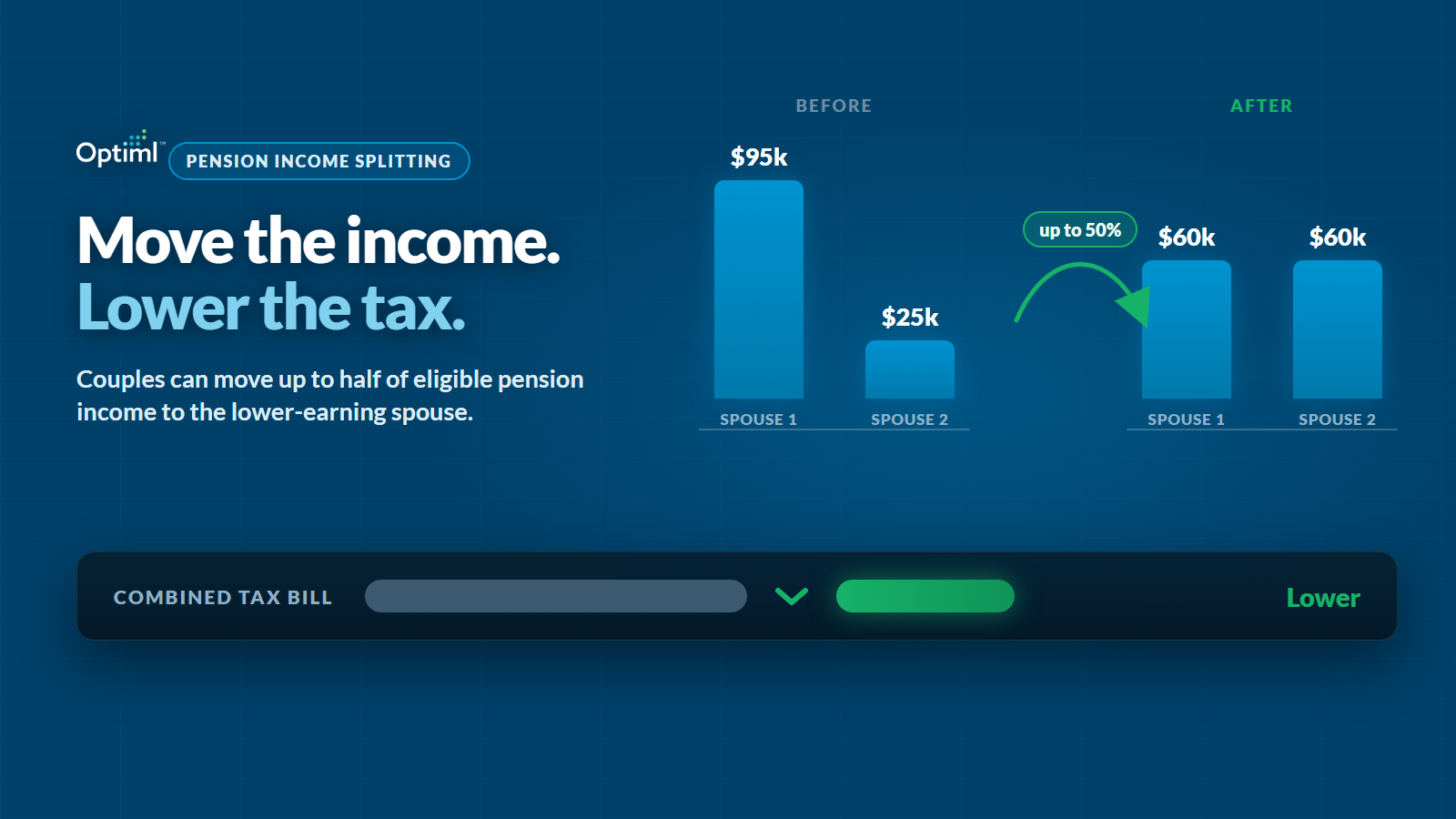
Note what that 50% applies to. It is 50% of eligible pension income, not 50% of your total income. He reports $95,000, but only $70,000 of it is eligible. So the most he can move is $35,000, not $47,500. His CPP and his investment income are stuck on his return no matter what he does.
And $35,000 is exactly the number that makes this couple interesting. Move the full 50%, and he drops from $95,000 to $60,000. She rises from $25,000 to $60,000.
Two identical returns. Same $120,000 household. Same deposits into the same accounts. A materially different combined tax bill.
The age gate almost nobody explains
This is the section that earns the article, because it is where most coverage of pension splitting quietly goes wrong.
"Pension income is splittable at 65" is the version you usually hear. It is close enough to true to be dangerous, and it costs younger retirees real money.
The truth is that there are two doors, and they open at different times.
Registered Pension Plan (RPP) income, meaning lifetime annuity payments from a workplace pension, can be split at any age. Not 65. Any age. If you retired at 56 with a defined benefit pension, you can split that pension income with your spouse for the 2026 tax year. Every year you did not, assuming you had a lower-earning spouse, was a year you left the bracket gap open.
RRIF, LIF, and RRSP annuity income only becomes eligible once the spouse transferring it is 65 or older at the end of the year. Under 65, that income is not splittable, full stop.
So two 58-year-olds with identical $60,000 incomes get completely different answers, based purely on which envelope the money comes out of.
The age test looks at the spouse transferring the income, not the one receiving it. Her being 66 does not unlock anything. His being 67 unlocks his RRIF.
Which raises a question worth sitting with. If a workplace pension splits at any age and a RRIF only splits at 65, then when you turn your RRSP into a RRIF is not just a question about minimum withdrawals. It is also the year a splitting door opens. That is a timing decision, and timing decisions are exactly the kind of thing that should be modelled rather than guessed at.
CPP is not part of this
If you take one thing from this article, take this one.
CPP cannot be split using pension income splitting. It is not eligible pension income. It does not go on Form T1032. It does not count toward the 50%. Being 65, 70, or 80 does not change that.
This trips up a genuinely enormous number of people, and it is easy to see why. CPP is a pension. It has the word right in it. It shows up in retirement alongside the pension income you can split. So people assume it comes along for the ride, and it simply does not.
Here is where it gets confusing rather than just wrong: CPP has its own sharing mechanism, and it is a completely separate thing.
It is called CPP pension sharing, sometimes called assignment. And almost everything about it is different:
- You apply for it through Service Canada. It is not a tax election and it is not something your accountant does at filing time.
- It is not a 50% allocation of one person's benefit. It works on the CPP that both of you built up during the years you were together, which is a fundamentally different calculation.
- It has its own eligibility rules and its own application, and it stays in place until you cancel it or the rules end it. It is not re-elected every year the way T1032 is.
Two mechanisms. Two different agencies. Two different rulebooks. Electing one has no bearing on the other, and a couple can be doing both, one, or neither.
Be careful with any article that blurs the two together, because the practical consequences are real. If you assumed your CPP was getting split on your return, you have been mismodelling your income for years. And CPP has its own much larger lever anyway, which is when you choose to start it.
We ran it through Optiml
Back to our couple. Here is the before and after.
$35,000 crosses from a return where it was taxed at his top rate to a return where it fills brackets that were sitting empty. Their combined tax bill falls. Not because they earned less, or saved differently, or took on risk. Because $35,000 got reported by the person in the lower bracket.
I am deliberately not printing a savings number here, and I want to be straight about why. The honest answer depends on their province, their age credits, their other deductions, and their full income mix. Anyone who quotes you a clean dollar figure for "a couple at $95,000 and $25,000" is quoting you a number that belongs to a different couple. That is the entire reason this is worth modelling on your actual numbers rather than reading about.
What is worth noticing is the second-order effect, because it is where the quiet wins hide.
The pension income amount. There is a federal non-refundable credit on eligible pension income, calculated on up to $2,000. Before splitting, she has no pension income at all, so she has nothing to claim against. After splitting, she does. Depending on the source and the ages involved, that can mean the couple claims up to $2,000 each instead of once. Nothing about their finances changed. They just stopped wasting a credit that was sitting there.
The OAS interaction. The OAS recovery tax, the thing everyone calls the clawback, is measured against an individual's net income. Splitting lowers the higher earner's net income, which is precisely the figure being measured. For a couple sitting near the line, that can reduce or avoid a recovery that would otherwise have applied. It is worth reading our take on why losing some OAS isn't always losing before you organize your whole plan around avoiding it, but the mechanical point stands: this lever pulls on that one.
This is also the natural mirror of spousal RRSPs. Those equalize income on the way in, decades early. Pension splitting equalizes it on the way out, one year at a time. Couples who do both give themselves two shots at the same problem.
Equalizing is not always the answer
Here is the part almost nobody says out loud.
The maximum split is not automatically the optimal split.
Our couple landing on $60,000 and $60,000 is a satisfying picture. It is symmetrical. It feels finished. And in this particular year, for this particular couple, moving the full 50% is very likely the right call.
But "equalize the incomes" is a rule of thumb, and rules of thumb are exactly what Optiml exists to replace.
Allocating income to your spouse does not just lower your rate. It raises theirs. And their side of the return has its own machinery attached to their net income: credits that phase out, benefits that are income-tested, thresholds that live at specific numbers. Push too much across and you can trip something on their return that costs more than the bracket arbitrage gained. There are years where allocating $28,000 beats allocating $35,000, and the only way to know is to run both.
Now remember the rule from earlier: this is re-elected every year.
That single fact is the whole ballgame, and it is the most under-appreciated thing about pension splitting. It is not a switch you flip in the year you retire and forget. It is a dial you get to reset, from zero to the 50% maximum, every single year for the rest of your retirement.
Think about what changes across those years. RRIF minimums climb as you age. OAS starts. CPP starts, possibly at different ages for each of you. One of you sells a property and realizes a large gain. A rate changes. A credit phases in at 65 and another one shifts later. In every one of those years, the optimal allocation is a slightly different number.
A single-year tax calculator can tell you what to elect this April. It cannot tell you that electing less this year keeps you under a threshold that matters more in three years, when the RRIF minimum jumps. That is a full-horizon question, and it is the difference between filing well and planning well.
This is what every Optiml plan is built to answer. Withdrawal Optimization is what creates the eligible pension income in the first place, by modelling how much comes out of the RRIF, and when, across your whole retirement rather than one tax year at a time. Then Compare Plans lets you put split against no-split, or full-split against partial-split, side by side across the entire horizon and read the lifetime result rather than the April result. Your Success Score tells you whether the version you prefer still holds up when the markets do not cooperate.
And if you want to drive it yourself, you can test any what-if and fund it your way with Custom Plan, overriding the withdrawals that feed the split and watching what it does to the years that follow.
The paperwork
The mechanics are genuinely simple, which is a nice change of pace.
The election lives on Form T1032, Joint Election to Split Pension Income. A few rules to respect:
- It is a joint election. Both of you sign it. One of you cannot do this unilaterally.
- It goes on both returns. A copy attaches to each of your returns, for the same tax year, reporting the same amount. The numbers have to agree.
- It has a deadline. File it by your filing due date.
- The withheld tax travels with the income. This is the rule people miss. If you allocate 50% of the income, you must also allocate 50% of the income tax that was withheld at source on it. You cannot move the income to your spouse's return and keep the withholding on yours. They go together.
That last one is not a trap so much as a tidiness rule. It exists so the return reflects what actually happened. But it does mean the refund picture between the two of you shifts, sometimes in a way that surprises people who were only watching the tax owing.
One form. Two signatures. One deadline.
The Bottom Line
Pension income splitting is rare in that it asks nothing of you. You do not have to save more, invest differently, sell anything, or accept any risk you were not already carrying. The pension arrives exactly as it always did. You just tell the CRA who is reporting it.
But the version most couples run, elect the maximum and never look again, leaves the interesting part on the table. Because the ceiling is 50%, and the right answer is somewhere between zero and that ceiling, and it moves every year as your income mix moves.
So it is worth being precise about what this actually is. It is not a filing-season checkbox you tick once and inherit forever.
It is a decision you get to make again, every year, for the rest of your retirement.
Same money. Different return. Your call, annually.
Ready to optimize your retirement plan?
Join thousands of Canadians making smarter financial decisions with Optiml.
Start Free Trial