

Most advice on deferring OAS (Old Age Security) and CPP (Canada Pension Plan) is about longevity. Wait until 70, the argument goes, and a bigger, inflation-indexed cheque protects you against a long retirement.
But with $2 million or more invested, your portfolio already does that job. For a wealthy retiree, deferring CPP and OAS is mostly a tax-timing decision: which years carry your taxable income, how large your RRIF (Registered Retirement Income Fund) minimums get, and how much OAS is left after the recovery tax.
Deferring OAS and CPP to 70: the short answer
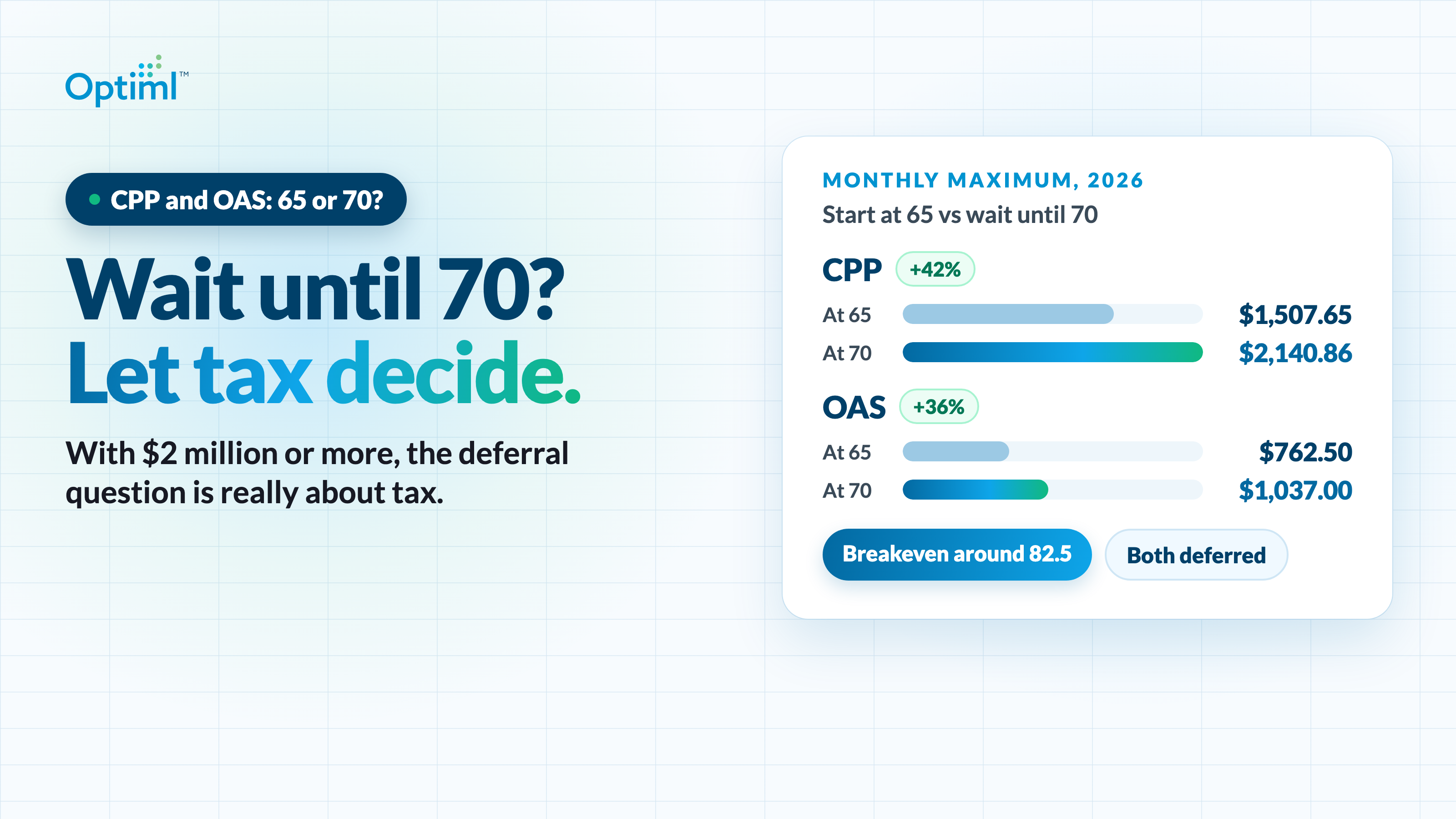
Deferring both benefits to 70 raises CPP by 42% and OAS by 36%. At the 2026 maximums, that's $907.71 more a month ($10,892.52 a year) for $136,209 of payments skipped from 65 to 70.
The simple combined breakeven is about 12.5 years after 70, around age 82.5, before investment returns and tax. With $2 million or more, breakeven is the wrong finish line. The real question is your taxable income from 65 to 85.
The 2026 numbers: what CPP and OAS pay at 65 vs 70
CPP and OAS reward waiting at different rates. CPP rises 0.7% for every month you start after 65 (8.4% a year), up to 42% at 70. Start it early and it drops 0.6% a month, up to 36% less at 60. Those are the CPP start-age rules.
OAS rises 0.6% for every month you defer (7.2% a year), for up to 60 months: 36% at 70. The increase stops at 70, so there's nothing to gain by waiting longer.
Deferral at a glance (monthly; CPP at the January 2026 maximum, OAS at the October to December 2026 maximum)
CPP amounts from 66 to 70 are calculated from the 0.7% rule, starting from the 2026 maximum of $1,507.65 a month. OAS amounts are canada.ca's October to December 2026 maximums by start age. Most people receive less than the CPP maximum: the average CPP pension at 65 is $858.34 a month (July 2026), or about $1,218.84 if deferred to 70 (calculated).
Two more OAS rules apply. At 75, the pension is also increased by 10% (the October to December 2026 maximum at 75 and over is $838.75 a month). And the figures above are full pensions. A full OAS needs 40 years living in Canada after 18. With fewer, it's prorated at your years in Canada divided by 40, and you need at least 10 years in Canada to qualify. If you want the fundamentals first, start with our guide to CPP and OAS.
Breakeven ages, and why they matter less with a large portfolio
Breakeven is the age at which the larger, later payments catch up with the ones you skipped.
Simple breakeven vs starting at 65 (no investment return, no tax, no indexing)
The pattern is a rule. CPP pays back about 11.9 years after you start it. OAS takes about 13.9 years. That holds whatever the start age, because the amount you skip and the amount you gain both scale with the months you wait.
Defer both to 70 at the maximums and you skip $136,209 to gain $10,892.52 a year. That's about 12.5 years, or around age 82.5.
Counting an investment return on the skipped payments pushes breakeven later, since that money could have stayed invested. And the larger payment is indexed to inflation for life, so the extra keeps its value for as long as you draw it.
OAS is the weaker deferral on pure math. Sixty payments of $762.50 is $45,750 skipped for $3,294 a year more. That long payback is why, for OAS, tax decides it.
With a large portfolio, breakeven carries less weight overall. You don't need a bigger cheque to fund a long retirement; your savings already cover that. What deferral does is move taxable income between years. The test is whether that move lowers your lifetime tax and protects your OAS. For the CPP-only version of this question, see when to take CPP at 60, 65 or 70 and our case study on CPP at 60 vs 70.
How deferring OAS interacts with the OAS recovery tax
The OAS recovery tax, often called the clawback, starts at $95,323 of net income on 2026 income. It's 15% of every dollar above that threshold, up to your full OAS. Canada.ca estimates full recovery at around $155,320 for ages 65 to 74.
Deferring OAS moves the clawback in two directions. It takes OAS out of your income from 65 to 69. Then, from 70, a larger OAS counts toward the net income the recovery tax is measured against.
Imagine a hypothetical retiree at 72 with a RRIF worth $1,500,000 on January 1. The minimum withdrawal at 72 is 5.40%, or $81,000. They receive the maximum CPP and a full OAS, and have no other income. Here's one year, both ways.
One year at 72 (illustrative, 2026 dollars)
Deferral adds $1,633.88 of recovery tax. It still leaves $1,660.12 more OAS a year, plus $7,598.52 more CPP, before income tax. The snapshot ignores income tax brackets, indexing, growth and the bridge-year draws in the next section, so it shows the mechanics, not a recommendation.
The zero-OAS point
At some income, OAS stops mattering. If your net income from 65 to 69 would sit above roughly $155,320 (on 2026 income), the OAS you'd collect in those years is fully recovered. Deferring it gives up little or nothing.
But the deferred pension has its own, higher ceiling. On our arithmetic, an OAS deferred to 70 ($12,444 a year) is fully recovered at about $178,300 of net income on 2026 income: $95,323 plus $82,960 ($12,444 divided by 0.15). The larger pension only pays off in the years your income sits below that line. If your income stays very high for life, deferring OAS gains little.
That's why we treat deferring OAS to avoid the clawback as a test, not a rule. Our 2026 OAS clawback guide covers the thresholds and the legitimate ways to reduce it, and here's why losing some OAS isn't always losing.
The bridge years: living on the portfolio while you defer
Deferring both benefits at the maximums means five years without $2,270.15 a month. That spending has to come from somewhere. When it comes from your RRSP (Registered Retirement Savings Plan) or RRIF, it changes what's left when the minimums start.
The RRIF minimum climbs every year from 71: 5.28% at 71, 5.40% at 72, 5.82% at 75 and 6.82% at 80. Every dollar drawn from 65 to 69 is a dollar that isn't in the RRIF when those percentages apply. Imagine the same retiree drew $300,000 from 65 to 69 to fund spending while both benefits were deferred.
Bridge-year effect (arithmetic, not a forecast; growth ignored)
That's $16,200 less forced income at 72. The gap widens as the factor climbs: on the same $300,000 difference, it's $17,460 at 75 and $20,460 at 80.
But the bridge draws are taxable too. You're not avoiding tax on that $300,000; you're choosing when to pay it. The real trade is filling lower brackets from 65 to 69, when CPP and OAS aren't adding to your income, against bigger forced income in your 70s and 80s, stacked on larger benefits and the recovery tax. We walk through that decade in the RRIF tax traps waiting in your 70s.
Couples: what pension income splitting can and can't move
For a couple, the bridge years have another angle. RRIF income is eligible pension income: when the spouse receiving it is 65 or older at year-end, up to 50% can be reported on the other spouse's return. CPP and OAS can't be split under pension income splitting.
So deferral changes the mix. From 65 to 69, income that would have been CPP and OAS, which stays on each spouse's own return, is replaced by RRIF income you can split. That works when the bridge money comes out of a RRIF; lump-sum RRSP withdrawals don't qualify. Then, from 70, the larger CPP and OAS land fully on each spouse's own return.
That matters because the recovery tax is assessed on each spouse's own net income. Two incomes close together can keep both spouses under the threshold where one large income and one small one can't.
A staggered approach, where one spouse defers and the other starts earlier, is a fair question to ask. Which spouse, which benefit and which age depend on both incomes and both RRIFs. It's a question to model, not a rule to copy.
When deferring costs you: a shorter retirement and the estate trade-off
Deferral is a trade. Here's what sits on the other side of it.
- The skipped payments are gone. Sixty months of CPP and OAS at the maximums is $136,209 you never receive. The larger payment only wins it back over time.
- The bigger payment pays off the longer you draw it. In a shorter retirement, the simple breakeven around 82.5 may never arrive, and starting at 65 comes out ahead.
- Your estate looks different. Deferring spends RRIF dollars in your 60s to fund a larger lifetime pension. Start at 65 instead and you leave a larger RRIF for a spouse or your estate. How that RRIF is taxed when it moves on decides whether that's the better outcome.
- No GIS while OAS is deferred. The Guaranteed Income Supplement (GIS) isn't payable while you defer OAS, and it doesn't increase when you delay. With $2 million, GIS rarely comes into play, but check it if your plan has very low-income years.
None of these make deferral wrong. They make it a decision with two sides, and your numbers pick the side.
How to test it on your own numbers
A breakeven chart leaves out your taxes, and with a large portfolio, taxes decide it. That's the part Optiml models.
Every Optiml plan, Essentials included, lets you set your own CPP and OAS start ages and see the effect on your taxes, the OAS clawback and your estate, year by year. Plans model the 0.7% and 0.6% CPP adjustments, the 0.6% OAS deferral increase, the 10% increase at 75, the 15% recovery tax, RRIF minimums and pension income splitting for couples.
The CPP & OAS Optimizer (Pro+ and Legacy) tests every combination of CPP and OAS start ages still open to you, for you and your spouse, and runs each one as a full plan. It ranks them by your plan's goal: after-tax estate value if you're maximizing your estate, lifetime spending if you're maximizing spending or targeting a set estate value. You see the OAS clawback and lifetime taxes for every combination, and any one of them can become your new plan with one click.
If keeping your OAS is the priority, Min OAS Clawback is a strategy you can choose. It minimizes your OAS clawback and keeps your benefits.
A checklist before you defer
- Your benefits at 65. Your CPP estimate, and whether you qualify for a full OAS (40 years in Canada after 18).
- Your income from 65 to 69, with and without the benefits. Would it sit above roughly $155,320 on 2026 income?
- Your RRIF minimums at 72, 75 and 80, with and without bridge draws.
- Your income after 70. Would a deferred OAS land below its own ceiling of about $178,300 on 2026 income (on our arithmetic)?
- Your spouse. Which income can be split, which can't, and whose return each benefit lands on.
- Your goal. Lifetime spending or after-tax estate, because the best start ages can differ between them.
- Your paperwork. Service Canada sends an enrolment letter around your 64th birthday and may enrol you automatically. To delay OAS, use My Service Canada Account or mail form ISP-3550, as set out on the OAS application page.
The Bottom Line
With $2 million or more, CPP and OAS aren't your protection against a long retirement. Your portfolio is. Deferral decides which years carry your taxable income, how big your RRIF minimums get and how much OAS survives the recovery tax.
Optiml runs every start-age combination through those years, for you and your spouse.
Run the years, not the breakeven.
Frequently asked questions
Can I defer OAS to 70?
Yes. You can delay OAS for up to 60 months after 65, so 70 is the latest start that earns an increase. Each month adds 0.6%, for 36% at 70, and the increase stops there. On the October to December 2026 maximum, that's $762.50 a month at 65 versus $1,037.00 at 70. At 75, the pension is also increased by 10%.
How do I delay OAS?
Service Canada sends an enrolment letter around your 64th birthday and may enrol you automatically. To delay, sign in to My Service Canada Account and, under Profile, choose "Delay Receiving OAS/GIS Pension." You can also mail form ISP-3550.
Does deferring OAS increase the clawback?
It can, in dollars. A deferred OAS is up to 36% larger, and it counts toward the net income the recovery tax is measured against: on 2026 income, 15% of every dollar above $95,323. For a hypothetical retiree at 72 with a $1,500,000 RRIF, deferring both CPP and OAS to 70 adds $1,633.88 of recovery tax but still leaves $1,660.12 more OAS a year. Deferral also takes OAS out of your income from 65 to 69, so if those years would have been clawed back, you give up less by waiting.
Is there an OAS deferral calculator?
The simple rule does most of the work. Each month you defer adds 0.6%, and the larger pension pays back the skipped payments about 13.9 years after it starts, whatever the start age. Start at 70 and the simple breakeven is around 83.9, before returns and tax. But a calculator that ignores your taxes misses the point: with a large portfolio, the recovery tax, your RRIF minimums and your tax bracket decide the answer. Optiml's CPP & OAS Optimizer (Pro+ and Legacy) runs every start-age combination through your full plan.
Should I defer both CPP and OAS?
Deferring both to 70 raises CPP 42% and OAS 36%. At the 2026 maximums, that's $907.71 more a month for $136,209 of skipped payments, a simple breakeven around age 82.5. With $2 million or more, the better test is your taxable income from 65 to 85. Deferral works best when the bridge years fill lower tax brackets and the larger pensions don't push your later income deep into the recovery tax. If your net income from 65 to 69 would sit above roughly $155,320 on 2026 income, the OAS you'd collect then is fully recovered anyway.
Ready to optimize your retirement plan?
Join thousands of Canadians making smarter financial decisions with Optiml.
Start Free Trial