

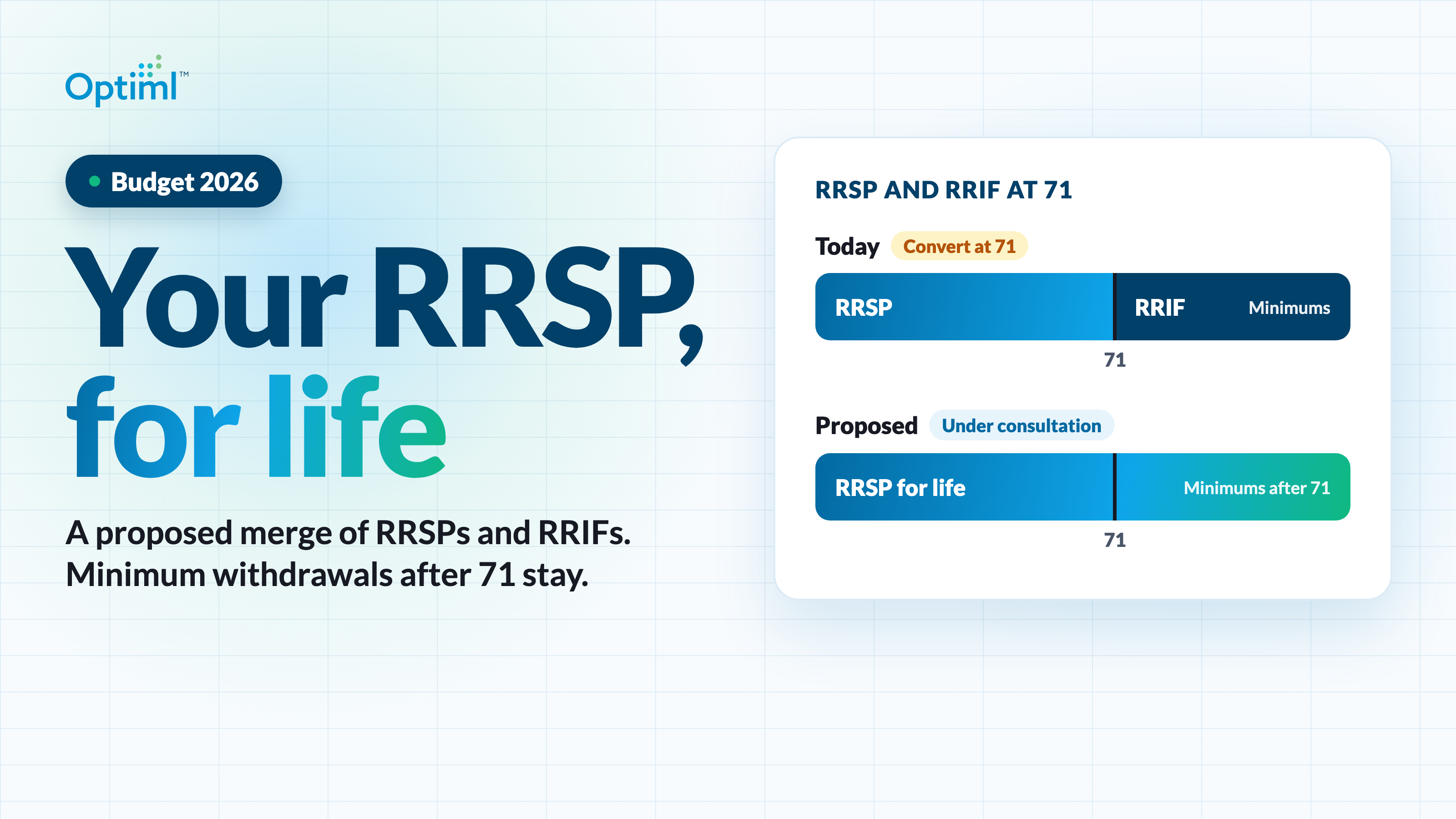
Budget 2026 proposes merging the core features of the Registered Retirement Savings Plan (RRSP) and the Registered Retirement Income Fund (RRIF) into one "RRSP for life," which would end the need to convert at 71. It's a consultation, not law. Minimum withdrawals after 71 would stay, and so would the tax on what you take out.
Canadian retirement planning has one hard line. At 71, your RRSP becomes a RRIF, minimum withdrawals begin, and the account's rules change. Budget 2026, tabled November 5, 2026, proposes to erase that line.
But the line was never what drove your tax bill.
Here's what's proposed, what's still unanswered, what it means for an RRSP meltdown, and the other Budget 2026 changes retirees should know, from a May 15 tax deadline to a higher instalment threshold.
What Budget 2026 proposes, and what's actually law
Nothing in this table is in force today. Here's where each retirement item stands.
Every item comes from the Budget 2026 tax measures supplementary information and Finance Canada's Budget 2026 key measures.
What "RRSP for life" would change
Today, your RRSP becomes a RRIF (or an annuity) by December 31 of the year you turn 71, and minimum withdrawals start the following year. We walked through that deadline in our RRSP-to-RRIF case study for Canadians turning 71.
Budget 2026 says the government intends to merge the core features of both accounts into a single RRSP for life. In the budget's words, this "would eliminate the need to convert an RRSP to a RRIF at age 71." One account, from your first contribution to your last withdrawal.
Two things stay put. If you're over 71, you'd still take a minimum withdrawal every year. And nothing in the budget changes how withdrawals are taxed. Every dollar out is still taxable income.
There's no start date. It's a consultation, with written submissions due January 8, 2027, and nothing has been legislated.
The survivor changes under consideration
Two more ideas are under consideration, both for when an RRSP or RRIF passes to a surviving spouse or common-law partner.
- A successor holder. Your spouse could take over the account and carry it on, the way a TFSA successor holder works today.
- Direct tax-free transfers. Today's indirect rollover steps would be replaced with a direct transfer into the survivor's own registered plan.
It's easy to read this as new tax relief for couples. It isn't. A surviving spouse or common-law partner can already receive an RRSP or RRIF tax-deferred, through a spousal rollover when they're the named beneficiary, and a RRIF can name them as successor annuitant. Full taxation on the final return is the default when there's no such designation, or when the beneficiary isn't a spouse or common-law partner.
The change being considered is about simplicity. Your survivor would carry on the account, with fewer steps in between.
What Budget 2026 doesn't say yet
The budget is silent on the details that matter most for planning. Treat each one as a question to watch while the consultation runs.
- Pension income. Today, RRIF payments at 65 and over count as eligible pension income for the pension income amount and pension income splitting. RRSP lump sums don't. Would withdrawals from an RRSP for life count?
- Withholding tax. Today, lump-sum RRSP withdrawals have tax withheld at source. RRIF payments up to the annual minimum don't. Which rule would apply?
- Minimum withdrawal factors. Would today's RRIF minimum withdrawal factors stay? And could you still base your minimum on a younger spouse's age?
- Contributions after 71. Today, you can't contribute to your own RRSP after the year you turn 71, but you can still contribute to a younger spouse's spousal RRSP. Would that change?
- Existing RRIFs. What happens to the accounts that have already converted?
We won't guess at any of them. But the first one matters most for your plan, and the next section shows why.
The merge removes paperwork, not the tax
What doesn't change is what drives your plan.
- Every registered withdrawal is still taxed as income.
- Minimum withdrawals still apply after 71.
- Without a spousal rollover, the balance is still taxed in full on the final return.
Imagine you're 72 with $600,000 in your RRIF. At today's minimum factor of 5.40%, that's at least $32,400 of taxable income that year, before a dollar of CPP or OAS. The minimum rises every year after, and on a larger balance it can push your income toward the OAS clawback threshold. Hold the same $600,000 in an RRSP for life and you'd still face a minimum withdrawal, and every dollar of it would still be taxed.
That's why the case for an RRSP meltdown hasn't changed. You draw your RRSP down in lower-income years, especially between retirement and 71, before minimums, CPP and OAS stack up. The aim is smoother taxable income across your lifetime and less exposure to the OAS clawback. We broke down the full strategy in The RRSP Meltdown Strategy, and the layers that build after 71 in The RRIF Tax Traps Waiting in Your 70s.
Where it could change the how and the when
Pension income is where the merge could change your plan.
Today, once you're 65, a dollar drawn from a RRIF counts toward the pension income amount, a federal credit on up to $2,000 of eligible pension income. You can also split it with your spouse through pension income splitting, moving up to half onto their return. The same dollar taken as an RRSP lump sum gets neither, and has tax withheld on the way out.
That gap is a big reason to convert part of an RRSP to a RRIF before 71, which we unpacked in Why More Canadians Should Consider a Partial RRSP-to-RRIF Conversion Before 71.
If withdrawals from an RRSP for life qualify as pension income at 65, that conversion step disappears. If they don't, the timing of your withdrawals matters more, not less. The budget doesn't say which. That's the detail we're watching.
What to do now
Nothing changes until legislation passes, and there's no draft yet. Plan on today's rules.
- Don't delay a planned withdrawal. Waiting on a consultation can cost you a low-income year you won't get back.
- Don't skip a meltdown year. The tax math behind it hasn't moved.
- Keep your plan current. Update it when the rules are final, not when they're proposed.
- Compare the two paths. Run a meltdown against the traditional withdrawal order on your own numbers.
That last step is where Optiml comes in. Optiml models every year of your retirement income, including RRIF minimums, the OAS clawback and pension income splitting between spouses, which it applies automatically. It counts RRIF withdrawals at 65 and over as eligible pension income, the way today's rules do.
Optiml's RRSP Meltdown strategy comes in Conservative, Moderate, Aggressive and Custom settings. It caps withdrawals at a tax bracket and at the OAS clawback threshold, stops short when your income is in GIS (Guaranteed Income Supplement) territory, and moves any surplus to your TFSA, then to non-registered savings. The goal-based strategies go a step further. They test meltdown approaches among their starting points and keep the best one for your goal.
And EVA, Optiml's AI assistant, can answer questions about your own plan and test a what-if before you change a thing.
Optiml plans under current law. The RRSP for life isn't law yet, so the plan you build today should run on today's rules.
The other Budget 2026 changes retirees should know
These are proposals too. Here's what each one would do, and when.
A May 15 tax deadline
The self-employed, who file by June 15 but pay by April 30 today, would pay by May 15 as well. Until then, nothing moves. Tax owing on your 2026 return is still due April 30, 2027.
A higher instalment threshold
This one matters to retirees whose RRIF, OAS and CPP income has no tax withheld. The balance comes due at tax time, and today quarterly instalments generally kick in once your net tax owing tops $3,000.
Budget 2026 proposes raising that threshold to $7,500 ($1,800 to $4,500 in Quebec), indexed and rounded to the nearest $500, for tax years from 2028. If your net tax owing lands between $3,000 and $7,500, quarterly instalments would no longer apply. Business-income earners could also make a single instalment of two-thirds by December 31.
Simpler claims
The three optional flat $1,000 claims let you claim a set amount instead of adding up costs.
- Moving Expense Deduction, from 2027, still limited to income earned at the new location.
- Home Accessibility Tax Credit, as a one-time claim, from 2027.
- Celiac disease, under the Medical Expense Tax Credit, from 2026.
A second round of simplification is set for the Spring Economic Update 2027.
Caregivers and households
A fully refundable Canada Caregiver Credit reaches about 585,000 caregivers, 180,000 of whom get nothing from it today. The $1,260 maximum is indexed after 2027. The Canada Groceries and Essentials Benefit is the former GST/HST credit.
What Budget 2026 didn't change
No changes were announced to OAS, GIS, CPP, the TFSA, the age amount, the pension income amount, the Home Buyers' Plan or the First Home Savings Account (FHSA).
The Bottom Line
Budget 2026 proposes one RRSP for life, with no conversion at 71. That's less paperwork. But the tax on every withdrawal, the minimums after 71 and the tax on your final return all stay, and those are what drive your plan.
So plan on today's rules, watch the pension income question, and let Optiml show you whether a meltdown beats the traditional order on your numbers.
Less paperwork. Same tax math.
Frequently asked questions
Is the RRIF being eliminated in Budget 2026?
No. Budget 2026 says the government intends to merge the core features of the RRSP and RRIF into a single RRSP for life, which would remove the need to convert at 71. It's a consultation with written submissions due January 8, 2027, and there's no effective date. Nothing has been legislated, and RRIFs work as they do today.
Do I still have to convert my RRSP to a RRIF at 71?
Yes, under current rules. By December 31 of the year you turn 71, your RRSP still becomes a RRIF or an annuity, or is withdrawn. The RRSP for life would remove that step only once it's legislated, and there's no start date yet.
Will RRIF minimum withdrawals change?
Nothing announced changes them. The proposal keeps minimum withdrawals for anyone over 71. The budget doesn't say whether today's factors or the younger-spouse age option would stay the same, so the current factors still apply.
Will withdrawals from an RRSP for life qualify for pension income splitting?
The budget doesn't say. Today, RRIF payments at 65 and over count as eligible pension income for the pension income amount and pension income splitting, and RRSP lump sums don't. Whether withdrawals from a merged account qualify is the key detail to watch.
What is a successor holder for an RRSP?
It's an idea under consideration in Budget 2026. A surviving spouse or common-law partner would take over the account and carry it on, as a TFSA successor holder does today. A spouse can already receive an RRSP or RRIF tax-deferred through a spousal rollover, so the change would be about simplicity.
When does the new May 15 tax deadline start?
It's proposed for the 2027 and later tax years, so the first May 15 deadline would be in spring 2028, for 2027 returns. It applies to all individuals, and the self-employed would pay by May 15 instead of April 30. Tax owing on your 2026 return is still due April 30, 2027.
Does Budget 2026 change OAS, CPP or the TFSA?
No changes were announced to OAS, CPP or the TFSA. The same goes for GIS, the age amount, the pension income amount, the Home Buyers' Plan and the FHSA.
Is the RRSP meltdown still worth it?
Nothing that drives it has changed. Registered withdrawals are still taxed, minimums still apply after 71, and without a spousal rollover the balance is still taxed in full on the final return. Drawing your RRSP down in lower-income years, before minimums, CPP and OAS stack up, can still smooth your lifetime tax and limit OAS clawback exposure. Whether it beats the traditional withdrawal order depends on your numbers, so compare both in your own plan.
Ready to optimize your retirement plan?
Join thousands of Canadians making smarter financial decisions with Optiml.
Start Free Trial