

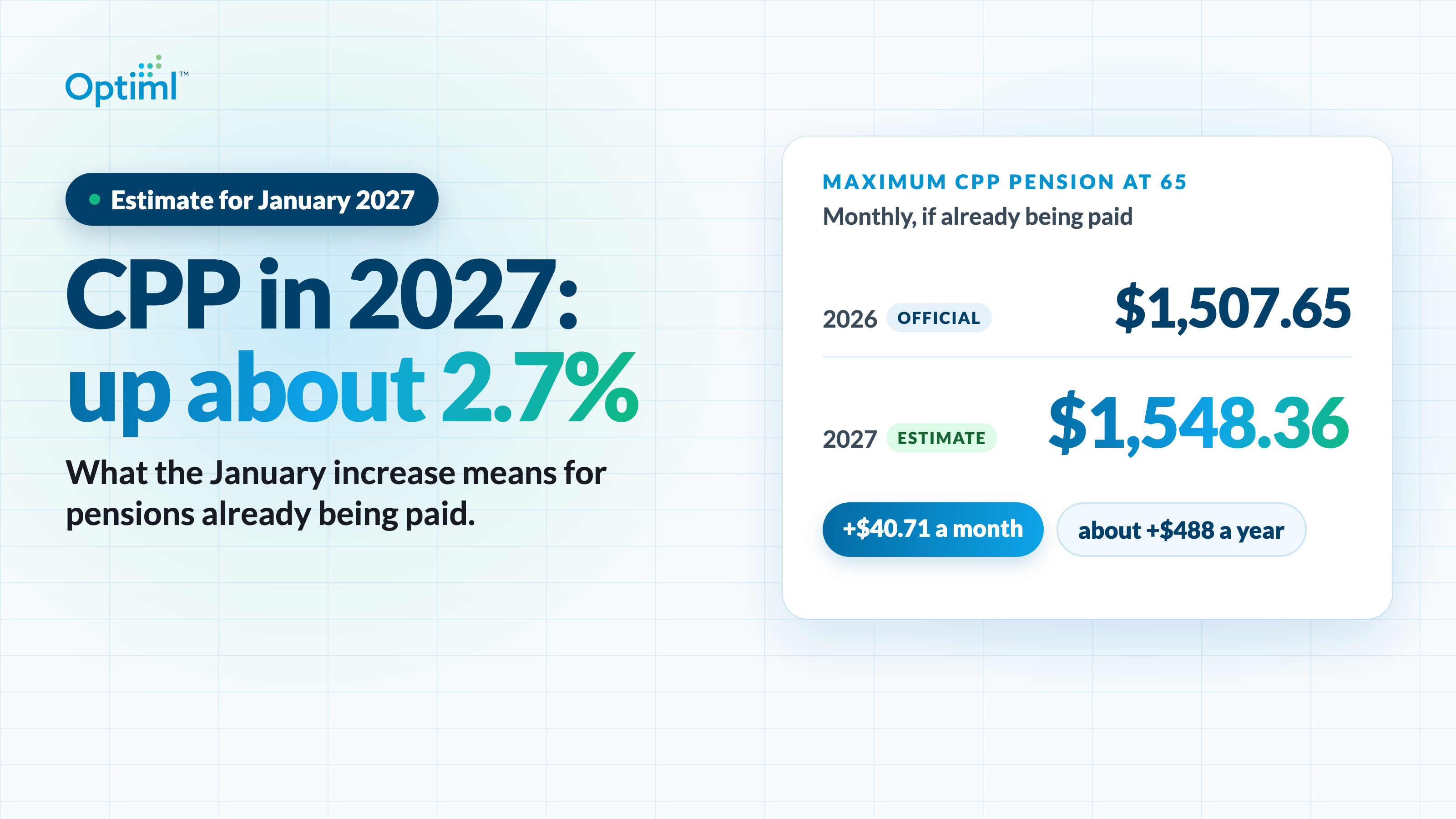
Canada Pension Plan (CPP) payments are expected to rise by about 2.7% in January 2027 for people already receiving them. At that rate, the maximum retirement pension at 65 would go from $1,507.65 a month to about $1,548.36, an increase of $40.71 a month.
The estimate comes from Jason Yee, principal financial analyst at Finepoint Solutions Inc. in Saskatoon, as reported by The Globe and Mail on October 23, 2026. He had been forecasting 2.6% and raised it to 2.7% after Statistics Canada reported September inflation of 3.1% year over year. For comparison, CPP rose 2.0% in January 2026.
The official figure comes later this year, so treat every 2027 number on this page as an estimate.
Searching for what you pay in rather than what you receive? The base contribution rate also falls in 2027, and we covered it in The CPP Contribution Rate Drops in 2027. That change leaves the benefit formula untouched. The January increase is something else: the yearly adjustment for inflation on benefits already being paid.
CPP amounts in 2026 and the estimated 2027 increase
Here's what a 2.7% increase looks like on the official 2026 amounts.
The 2026 maximums are for benefits starting in January 2026, and the average is for new beneficiaries as of July 2026, both from canada.ca. The 2027 column is our arithmetic at 2.7%, rounded to the cent. The post-retirement benefit is earned when you keep working and contributing after your CPP starts. The death benefit is a one-time payment and isn't indexed.
Over a full year, the maximum at 65 rises by about $488. The average new retiree's pension rises by about $278.
Small on their own. But indexation compounds: each January's increase is applied to the amount after the last one, for as long as you receive CPP.
How the January CPP increase is calculated
September's inflation rate was 3.1%. So why is the estimate 2.7% and not 3.1%?
Because CPP doesn't follow any single month. Once a year, in January, CPP amounts are adjusted by the change in the average Consumer Price Index (CPI) over the 12 months from November to October, compared with the same 12 months a year earlier.
Here's how that formula produced the 2026 increase:
- November 2023 to October 2024: average CPI of 160.4
- November 2024 to October 2025: average CPI of 163.6
- Change: 2.0%, applied to CPP payments in January 2026
For a 2.7% increase in January 2027, the average for November 2025 to October 2026 needs to land at about 168.0. That's our arithmetic: 163.6 × 1.027.
The averaging is why one hot month moves the estimate only a little. September is one month out of twelve, so a 3.1% reading nudged the forecast from 2.6% to 2.7%. Much of that jump came from gasoline, which was up sharply from a year earlier; excluding gasoline, CPI rose about 2.2%.
The formula only works in one direction. If the average falls, CPP amounts stay where they are. They never go down.
When the 2027 increase becomes official
October's CPI, released by Statistics Canada in mid-November, is the last input. After that, Employment and Social Development Canada (ESDC) confirms the official rate and the new amounts, usually in late November or December. The increase then applies from your January 2027 payment.
Who gets the January increase
The January increase applies to pensions already being paid. If you're receiving CPP now, it's automatic. There's nothing to apply for.
Starting CPP in 2027 works differently. Your starting amount is calculated from your own contributions and the earnings limits in place at that point. So $1,548.36 isn't the 2027 maximum for new claimants. It's what someone already receiving the 2026 maximum would be paid. The maximum for a pension starting in 2027 hasn't been published yet.
That starting amount also includes any enhanced CPP you've built since 2019, including CPP2 on earnings between the first and second ceilings. Here's CPP2 explained. Once your pension starts, the whole amount is indexed every January from then on.
Then there's your start age, which moves your number far more than any single year of indexation:
- Before 65: 0.6% less for each month early, down 36% at 60
- After 65: 0.7% more for each month you wait, up 42% at 70
Indexation applies to whatever amount you lock in. A larger starting pension gets a larger raise in dollars every January, for as long as it's paid. We ran the full comparison in When to take CPP: 60, 65 or 70.
The tax side: CPP and the OAS clawback
A raise is worth what you keep of it. CPP is taxable income, and it counts toward the net income used for the Old Age Security (OAS) recovery tax, often called the clawback.
On 2026 income, the clawback starts at $95,323, and the recovery tax is 15% of each dollar of net income above it. That's the threshold for the 2026 income year, and it's indexed too, so it rises over time.
For most retirees, the January increase won't change which side of that line they're on. But if your income sits just under it, a larger CPP cheque, stacked on Registered Retirement Income Fund (RRIF) withdrawals, OAS itself and any workplace pension, can nudge you over. That's why CPP timing, OAS timing and the order you draw your accounts belong in the same decision.
OAS also runs on a different clock. It's indexed to the CPI every quarter, so it adjusts in smaller steps through the year. CPP adjusts once, every January.
What a 2.7% year means for your plan
One year of 2.7% won't rewrite your retirement. But the inflation assumption behind it runs through every year of your plan, and it moves more than CPP.
Every Optiml plan indexes CPP and OAS, along with tax brackets, credits and contribution limits, using your plan's inflation assumption. It defaults to 2%, and you can change it. Set it higher and you see what stronger indexation does to the whole plan: your CPP and OAS income, the brackets that income lands in, how close you come to the OAS clawback, and the order Optiml draws from your Registered Retirement Savings Plan (RRSP) or RRIF, your Tax-Free Savings Account (TFSA) and your non-registered accounts.
Optiml's CPP & OAS Optimizer models your start ages for both benefits against that same picture, so timing and indexation are tested together. And EVA, Optiml's AI assistant, answers what-if questions about it on your own plan, like what a 3% inflation assumption would do to your income and your tax bill.
The Bottom Line
CPP payments are expected to rise about 2.7% in January 2027, taking the maximum at 65 from $1,507.65 to about $1,548.36 a month for people already receiving it. October's CPI sets the final number, and ESDC confirms it late in the year.
The increase is automatic. What it's worth to you isn't. That depends on when you start CPP, how it stacks with OAS and your other income, and which accounts you draw first.
Optiml models those together, across every year of your plan.
January sets the raise. Your plan decides how much of it you keep.
Frequently asked questions
Will CPP payments increase in January 2027?
They're expected to. The current estimate is about 2.7% in January 2027 for people already receiving CPP, from Jason Yee, principal financial analyst at Finepoint Solutions Inc., as reported by The Globe and Mail on October 23, 2026. The official rate is confirmed after October's inflation data is released in mid-November. For comparison, CPP rose 2.0% in January 2026.
What is the maximum CPP payment in 2027?
For someone already receiving the 2026 maximum at 65 of $1,507.65 a month, a 2.7% increase would mean about $1,548.36 a month in 2027, roughly $488 more a year. The maximum for a pension starting in 2027 hasn't been published yet. It's calculated from contributions and the earnings limits in place at that point, and Employment and Social Development Canada usually publishes the new amounts in late November or December.
How is the CPP increase calculated?
CPP is adjusted once a year, in January, by the change in the average Consumer Price Index for the 12 months from November to October, compared with the previous 12 months. For 2026, the average rose from 160.4 to 163.6, an increase of 2.0%. If the average falls, CPP amounts stay the same. They never go down.
When will the official 2027 CPP increase be announced?
October's CPI, released by Statistics Canada in mid-November, is the last month in the calculation. Employment and Social Development Canada then confirms the official rate and the new amounts, usually in late November or December. The increase applies from the January 2027 payment.
Does a higher CPP payment affect the OAS clawback?
It can. CPP is taxable income and counts toward the net income used for the OAS recovery tax. On 2026 income, the clawback starts at $95,323, and the recovery tax is 15% of each dollar of net income above it. The threshold is indexed too. For most retirees the January increase changes nothing here, but if your income sits just under the threshold, a larger CPP cheque can nudge you over it.
Ready to optimize your retirement plan?
Join thousands of Canadians making smarter financial decisions with Optiml.
Start Free Trial