

Most Canadians treat the Tax-Free Savings Account (TFSA) as the account they get to last. Bills first, mortgage first, Registered Retirement Savings Plan (RRSP) contribution for the tax refund, and then whatever is left over trickles into the TFSA. It feels responsible.
But there is a quiet problem hiding in that order. By the time many Canadians reach their mid-50s, they have built up an enormous amount of unused TFSA room and very little inside the account to show for it. And the years where that gap is cheapest and most powerful to close are the exact years they are in right now.
So we built the scenario and ran the math. Here is what catching up did.
The starting point: a real gap, not a hypothetical one
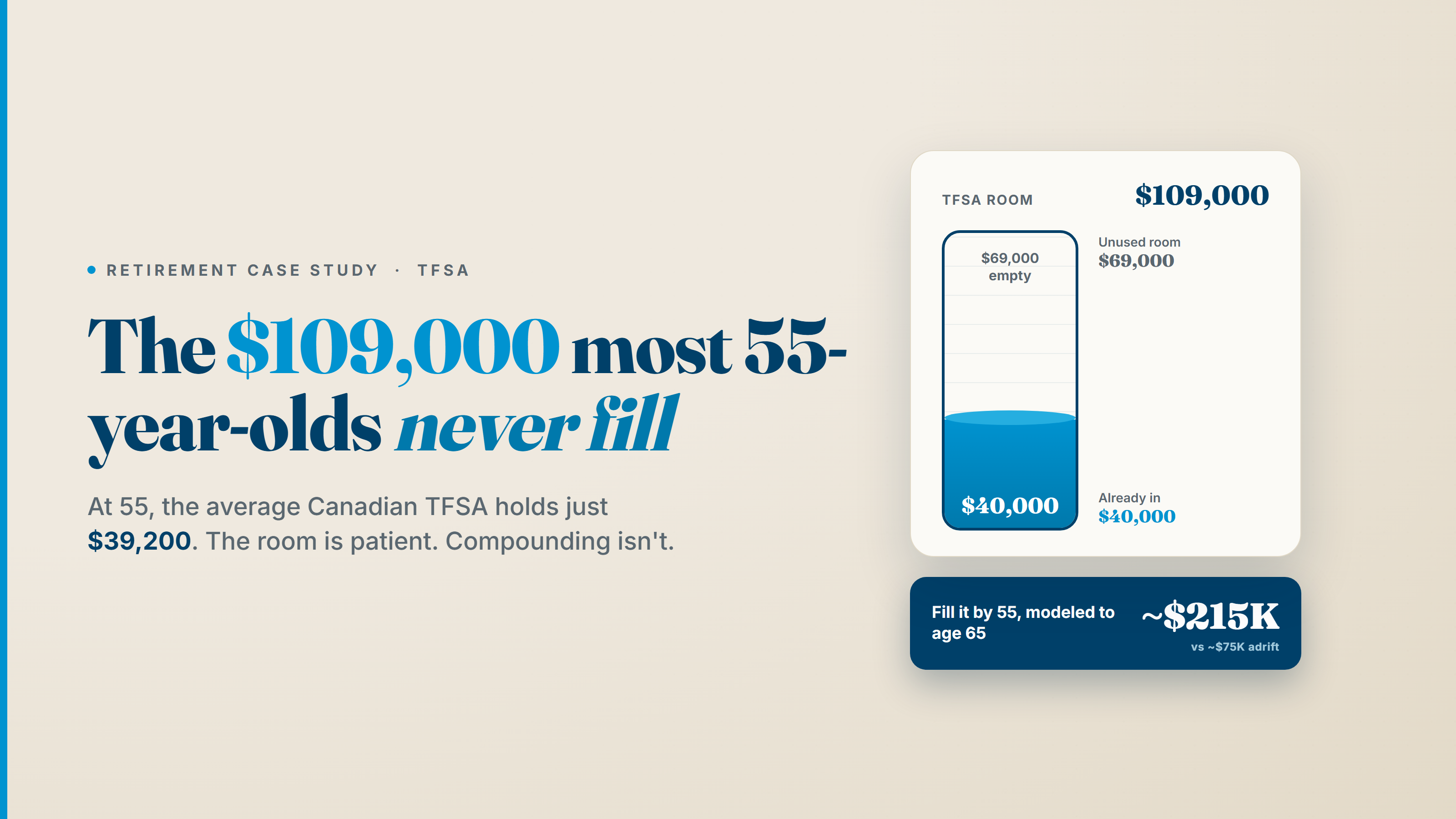
Fresh 2026 data tells a consistent story. The average 55-year-old Canadian household holds roughly $39,200 inside their TFSA. Cumulative TFSA room for someone who was 18 when the account launched in 2009 now sits at about $109,000.
That is a gap of nearly $70,000 of unused tax-free space. Not because people did anything wrong, but because the TFSA almost always loses the priority contest to the mortgage, the kids, and the RRSP refund.
So we modeled a realistic version of that household. Meet our scenario.
This is a saver who did a lot right. A solid RRSP, a paid-down life, money in the bank. The one thing left on the table is that $109,000 of empty tax-free space, and a chunk of taxable money sitting beside it generating a Canada Revenue Agency (CRA) tax slip every single year.
The two paths we compared
We used Compare Plans to run two versions of the same person, side by side, all the way to age 90.
Path A, the drift. Keep doing what most people do. Trickle a little into the TFSA when it is convenient, leave the $140,000 in the taxable account, and let the RRSP grow untouched until mandatory Registered Retirement Income Fund (RRIF) withdrawals force the issue at 71.
Path B, the deliberate catch-up. Over the next several pre-retirement years, intentionally move money into the TFSA. The annual surplus goes there first, and the taxable $140,000 gets swept across into the TFSA as room allows, filling the $109,000 gap well before retirement.
Same income. Same retirement age. Same spending. The only variable is whether the tax-free room gets filled on purpose or left to drift.
Why the pre-retirement window is the cheap window
Here is the part that makes the timing matter. Moving that taxable $140,000 into the TFSA is not free. Selling the taxable holdings can trigger capital gains, and you want to spread that realization across years rather than dumping it all into one tax bill.
But the pre-retirement years are the ideal time to absorb that. Once the money is inside the TFSA, every dollar of growth from that point forward is permanently invisible to the CRA. It never shows up as income. It never counts toward the Old Age Security (OAS) clawback threshold. It never gets taxed on the way out.
That last point is the one most people underestimate. A dollar in your taxable account is taxed every year it grows. The same dollar inside your TFSA grows untouched, forever. Ten or fifteen years of compounding is exactly where that difference becomes real money.
What Optiml surfaced
When we ran both paths through Optiml, the deliberate catch-up did three things the drift never could.
It shut off an annual tax leak. That $140,000 taxable account was generating taxable interest, dividends, and realized gains every year. Sweeping it into the TFSA over the pre-retirement years stops those slips for good. The growth keeps happening; the tax bill on it disappears.
It built a tax-free withdrawal lever for retirement. A fully funded TFSA gives Optiml something powerful to work with in decumulation: a pool of money that can be drawn down in any year without adding a single dollar to taxable income. In the years where pulling from the RRIF would push income up toward the OAS clawback threshold, every Optiml plan can lean on the TFSA instead and keep income below the line.
It changed the shape of the RRIF problem. With more flexibility on the withdrawal side, the plan can draw the RRSP down a little more deliberately in the early retirement years (a lighter version of the RRSP Meltdown), instead of being forced into large mandatory RRIF minimums later that arrive whether the money is needed or not.
The numbers, side by side
Here is what the two modeled paths produced over the full plan. These figures are the output of this specific scenario, not a promise about your situation. Your own gap, income, and timeline would generate different numbers.
The headline is not just that the catch-up plan ended with a bigger pile. It is where the money ended up. In Path B, a large share of the final estate sits inside the TFSA, which passes to a beneficiary tax-free. In Path A, more of the estate is still trapped inside the RRIF, where the entire balance is deemed received as income in the year of death and taxed at the top marginal rate. Same saver, very different tax bill on the way out.
The catch most people miss about TFSA room
There is a reason the pre-retirement window matters so much, and it is easy to overlook: your unused TFSA room does not expire, but the years to compound inside it do.
You can always catch up the room itself. What you cannot get back is a decade of tax-free growth you skipped. $109,000 of room filled at 55 and left to grow for fifteen years is a fundamentally different number than the same room filled at 70. The space is identical. The runway is not.
That is the whole argument for treating the catch-up as a deliberate project rather than a someday intention. The room is patient. Compounding is not.
How to see your own version of this
The scenario above is one modeled saver. Your gap might be smaller or larger. You might have a spouse to split income with, a pension changing the picture, or a different retirement date. All of that changes the answer.
That is exactly what Optiml is built to model. You enter your real RRSP, TFSA, and non-registered balances, your income, and your retirement timeline, and every Optiml plan determines the optimal sequence to fill the tax-free room and draw it back down, year by year, to lower your lifetime tax bill. Compare Plans lets you put the drift and the deliberate catch-up next to each other, exactly like we did here, and EVA can walk you through why the plan moves each dollar the way it does.
The Bottom Line
A $40,000 TFSA next to $109,000 of empty room is not a failure. It is one of the most common, and most fixable, situations in Canadian retirement planning. The pre-retirement years are the cheapest, highest-leverage window to close that gap, because every dollar you move into the account now gets the longest possible runway of growth the CRA will never touch.
The room will still be there at 70. The compounding will not.
Fill it on purpose. That is the difference between drifting toward retirement and planning for it.
Ready to optimize your retirement plan?
Join thousands of Canadians making smarter financial decisions with Optiml.
Start Free Trial