

Most Canadians spend their working years being told to defer tax. Contribute to the RRSP (Registered Retirement Savings Plan), let investments compound, and put off the tax bill for as long as possible. It is good advice while you are earning.
But there is a window in early retirement where that instinct works against you.
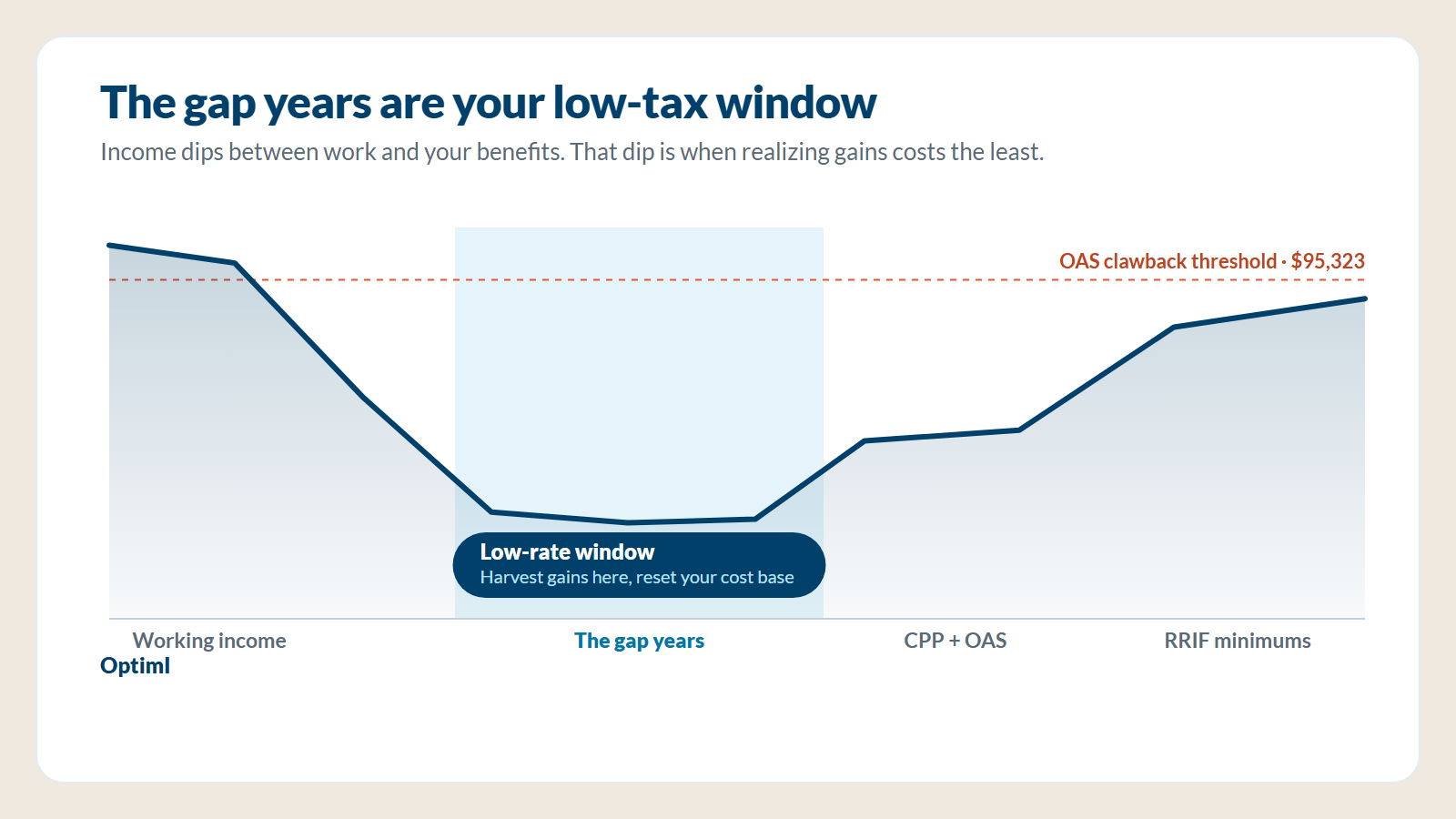
It is the stretch between the day you stop working full-time and the day your income ramps back up. Canada Pension Plan (CPP) and Old Age Security (OAS) have not started yet, or you have deliberately deferred them. Your RRSP has not been converted to a RRIF (Registered Retirement Income Fund), so mandatory minimum withdrawals are not forcing income onto your return. For many people these "gap years" are the lowest-income, lowest-marginal-rate years of their entire adult life.
So why let that low-rate room sit empty?
The mechanic: realize a gain on purpose
Tax-gain harvesting is the deliberate opposite of deferral. You sell an appreciated holding in a non-registered account to trigger a capital gain (the difference between what you paid and what it is worth now), pay the tax while your rate is low, and reset your cost base higher.
Your adjusted cost base (ACB) is the tax value of what you own, roughly what you paid plus reinvested distributions. When you sell, the gain above your ACB is taxable. When you rebuy, your new ACB is the price you just paid.
Here is why that matters. Imagine you hold $200,000 of an index fund in a non-registered account with an ACB of $120,000. That is an $80,000 unrealized gain sitting there waiting. If you sell it all decades from now in a high-income year, that gain gets taxed at a high marginal rate. If you realize a slice of it now, in a year where your other income is low, that same gain is taxed at a much lower rate, and your ACB steps up so there is less gain left to tax later.
You are not avoiding the tax. You are choosing to pay it in your cheapest year instead of your most expensive one.
Gain harvesting vs loss harvesting
If you read our earlier piece on capital-loss harvesting, this is the mirror image. Loss harvesting is about selling losers to offset gains. It comes with the superficial-loss rule: sell at a loss and rebuy the same security within 30 days and the loss is denied.
Gain harvesting has no equivalent restriction. There is no "superficial gain" rule in Canada. You can sell an appreciated holding to crystallize the gain and rebuy the identical security the same day, with no waiting period and no gap in market exposure. Your position is unchanged; only your ACB moves.
One number to be clear on: the capital gains inclusion rate for individuals in 2026 is 50%. Half of every realized gain is added to your taxable income. The proposed increase to 66.7% was cancelled in March 2025. It is not deferred and it is not in flux. The planning number is 50%.
Who this is for, and who it is not
Tax-gain harvesting only works in non-registered accounts. Inside an RRSP, a RRIF, or a TFSA (Tax-Free Savings Account), trades do not generate capital-gains treatment at all. You can buy and sell inside those accounts freely with no tax event, so there is no cost base to reset and nothing to harvest.
This strategy fits you if two things are true at once:
- You hold meaningful unrealized gains in a taxable non-registered account.
- You have a genuinely low-income year in front of you, most often those gap years before CPP, OAS, and RRIF minimums kick in.
It is the wrong move if you are already in a high bracket, if your portfolio is almost entirely registered, or if realizing the gain would push your income across a threshold that costs you more than the harvest saves. The point is precision, not enthusiasm.
Harvest to a ceiling, not to zero
The discipline is everything. This is a "fill the low-rate room" strategy, not a "sell everything and pay the tax" strategy.
You harvest gains up to a deliberate ceiling: the top of a favourable tax bracket, or the OAS clawback threshold. For the 2026 income year, OAS begins to be recovered once net income passes $95,323, at 15 cents on every dollar above it. If you are already collecting OAS, or will be soon, stacking a large realized gain on top of your other income can trigger that recovery and erode the benefit of the harvest.
Two more watch-outs:
- GIS sensitivity. If any Guaranteed Income Supplement is in play, realized gains count as income and can reduce it sharply. For lower-income retirees, harvesting can backfire.
- Provincial bracket stacking. Your true marginal rate is federal plus provincial combined. A gain that looks cheap federally can land in a steeper provincial bracket depending on where you live.
Realize up to the line you have chosen. Then stop.
Get the timing right at year-end
Capital gains land in the tax year the trade settles, not the year you place the order. Canadian equity trades settle on a T+1 basis, one business day after the trade.
That means a trade placed on December 31 may not settle until January, pushing the gain into the following year. To be certain a gain lands in the current year, place the trade by roughly December 30, and give yourself a buffer around holidays and weekends. Do not leave it to the last afternoon.
How to model it in Optiml
The hard part of this strategy is not the trade. It is knowing which years are actually your low-rate years, and how much room you have before you hit a bracket or the OAS threshold. That requires seeing your whole retirement at once, not a single tax return.
Optiml models your household taxable income across your full retirement horizon. You can see exactly which years have low-rate room and which years RRIF minimums, CPP, and OAS push your income up, all of it OAS-clawback-aware as part of how every plan sequences your withdrawals.
And you can model gain harvesting directly. In Advanced Settings, Optiml has a capital gains realization rate: you set the percentage of unrealized gains in your non-registered accounts to realize each year, then watch the multi-year tax impact flow through your plan. Turn it up in your gap years, see what it does to lifetime tax, and dial it to the level that fills the low-rate room without tipping into a clawback.
From there, the Detailed Taxes view shows the year-by-year tax picture, and Compare Plans lets you put a harvest-in-the-gap-years plan side by side with a do-nothing plan and see the difference across your whole retirement.
The Bottom Line
The gap years do not last. Once CPP, OAS, and RRIF minimums arrive, your income floor rises and the low-rate room closes for good.
Used with discipline, tax-gain harvesting turns that short window into a lasting advantage: pay a little tax now at your cheapest rate, reset your cost base, and carry a lighter tax bill through the rest of retirement.
Tax-gain harvesting isn't about paying tax early for its own sake. It's about paying it in the year it costs you the least.
Frequently Asked Questions
What is tax-gain harvesting?
Tax-gain harvesting is deliberately selling an appreciated holding in a non-registered account to trigger a capital gain in a low-income year. You pay the tax now while your marginal rate is low, and your adjusted cost base resets higher, so there is less gain left to tax when you eventually sell for real.
Is there a superficial gain rule in Canada?
No. The superficial-loss rule (the 30-day rule) applies only to losses. There is no equivalent rule for gains, so you can sell a holding to realize a gain and rebuy the identical security the same day, with no waiting period and no gap in market exposure.
What is the 2026 capital gains inclusion rate?
For individuals in 2026 the inclusion rate is 50%, meaning half of every realized gain is added to taxable income. The proposed increase to 66.7% on gains above $250,000 was cancelled in March 2025. It is not deferred and not in flux.
Does tax-gain harvesting work in an RRSP or TFSA?
No. It only works in non-registered (taxable) accounts. Inside an RRSP, RRIF, or TFSA, trades do not generate capital-gains treatment, so there is no cost base to reset and nothing to harvest.
When should I make the trade at year-end?
Capital gains land in the tax year the trade settles, not the year you place the order. Canadian equity trades settle on a T+1 basis, so to be sure a gain counts this year, place the trade by roughly December 30 and leave a buffer around weekends and holidays.
How do I model tax-gain harvesting in Optiml?
In Advanced Settings, Optiml has a capital gains realization rate. You set the percentage of unrealized non-registered gains to realize each year and watch the multi-year tax impact flow through your plan. The Detailed Taxes view shows the year-by-year picture, and Compare Plans lets you put a harvest plan beside a do-nothing plan across your whole retirement.
Ready to optimize your retirement plan?
Join thousands of Canadians making smarter financial decisions with Optiml.
Start Free Trial