

Most people assume Canadians sort neatly into two groups: the ones who build their own retirement plan, and the ones who hand the whole thing to a professional. But almost nobody we talk to actually lives in one camp.
They build. Then, once in a while, they want someone qualified to look at what they built.
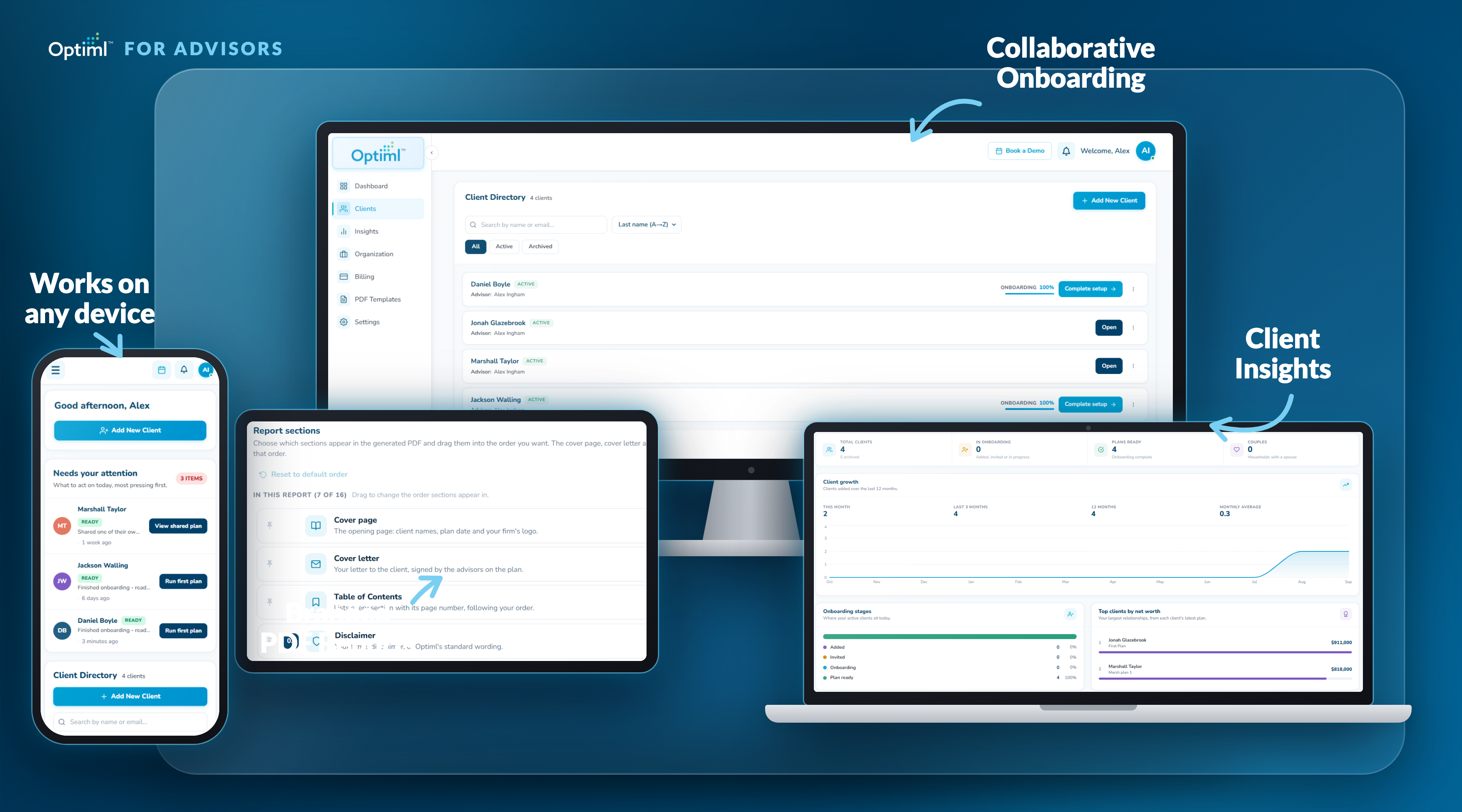
That's the gap we've spent this year closing, and it's why Optiml now has a version made for advisors. Before I explain any of it, let me be direct about the part that matters most to you.
The self-directed plan is still the point
Optiml was built for the Canadian who wants to run the numbers themselves. That hasn't changed, and it isn't going to.
Thousands of Canadians use Optiml to build and manage their own plans, and more than 200,000 retirement plans have been run through the platform. Everything we ship for individuals keeps shipping: the withdrawal sequencing, the Success Score, the CPP & OAS Optimizer, Compare Plans, the Custom Plan controls. The roadmap for the self-directed product is as full as it has ever been.
The advisor version is additive. It's a second version of Optiml sitting alongside the one you already use, running on the same engine. Nothing about your plan, your account, or your pricing changes because it exists.
What changes is what becomes possible when your advisor happens to work in the same tool you do.
The pattern we kept hearing, from both sides
This didn't start as a strategy meeting. It started as a pattern in our inbox.
On one side, advisors were signing up for a consumer product and using it to build client plans. They weren't confused about what Optiml was. They wanted the Canadian tax engine, and they were working around the fact that the tool was designed for one household at a time.
On the other side, Optiml users were asking a version of the same question: can I get a professional to look at this with me? Not to take it over. To confirm it, challenge it, or answer one specific question before a big decision.
That second group is bigger than the industry tends to admit. The J.D. Power 2026 Canada Investor Satisfaction Study, fielded from September 2025 to January 2026 across 4,529 advised investors and 2,882 do-it-yourself investors, found this:
Read that carefully, because it isn't a story about people giving up on doing it themselves. It's a story about people who are good at this wanting a professional in the room at specific moments.
The Canadian Securities Administrators has published research along the same lines, describing hybrid DIY investors who self-direct most of the time and bring in professional guidance periodically. That's the shape of the market. Optiml should fit it.
The same four questions, answered by the same engine
Ask an advisor what clients actually walk in with, and you get the same four questions all day long. They are, almost word for word, the four questions you have already been running in Optiml on your own.
- When can I retire? Optiml models the earliest realistic date against your actual accounts, your real spending, and the goals you've told it about.
- How should I withdraw my money? Optiml optimizes the drawdown order across your Registered Retirement Savings Plan (RRSP), Tax-Free Savings Account (TFSA), Registered Retirement Income Fund (RRIF), Locked-In Retirement Account (LIRA), non-registered and corporate accounts.
- When should I take CPP and OAS? Every Canada Pension Plan (CPP) and Old Age Security (OAS) start age from 60 to 70 gets tested, including the OAS clawback and pension income splitting.
- Will I run out of money? The Success Score stress-tests your plan across 50 market scenarios, so the answer comes back as a number instead of a reassurance.
Here's why that matters now. The advisor version runs on that same engine, with those same four questions at the centre of it.
So when a professional opens your plan, they are not starting a different conversation with different assumptions and a different answer. They're looking at your work, in your model, and adding judgement to it.
What we've built, in plain terms
The advisor version of Optiml is a workspace for professionals, launching in full later this year. Most of it is built for them, but several pieces land directly on your side of the table:
- You enter your own information once. Through a secure invite, in your own time, instead of weeks of back-and-forth reading account balances aloud over the phone.
- Your advisor models year by year on the same Canadian retirement and tax engine you already use.
- You get an interactive digital plan, not a static printout. You can open it and explore it, alongside a PDF report branded as your advisor's firm, with their sections and their disclosures.
- You create your own plan versions and test changes yourself.
- EVA is there on both sides. Optiml's AI planning assistant can answer questions about the plan and summarize the key details, whether you're the one reading it or your advisor is preparing for your meeting.
- Read-only access, so you can see a shared plan without anyone worrying about accidental edits.
- Two-way plan sharing.
There's a firm-side layer underneath all that too: household management across a whole book of clients, multi-office and multi-advisor structure, insights across their client base. Useful to them, invisible to you, and the practical effect is that your advisor spends the time on advice instead of admin.
But I want to sit on the fourth item for a second, because I think it's the one this audience will care about most.
In a traditional advice relationship, every what-if costs you an email and a wait. What if I retire at 62 instead of 65? What if we sell the cottage five years earlier? What if returns come in at 5% instead of 7%? You ask, you wait days, you get one answer back, and by then you've thought of three more questions.
That's not how you work. You'd rather just try it.
Now you can. You build your own versions of the plan and run the scenarios yourself, then bring the interesting ones to your advisor. The instinct that made you a self-directed planner in the first place doesn't have to get checked at the door.
Your plan can now move in both directions
Think about what usually happens when a self-directed Canadian brings a plan to a professional.
You export a PDF and print it. You spend the first forty minutes explaining your assumptions: your inflation rate, your retirement age, why you modelled the cottage sale at 74, what you assumed about your spouse's CPP start date. Then the advisor re-enters your numbers into their own software, which produces a different answer for reasons neither of you can fully trace.
Two tools that never talk to each other. That's the single biggest friction in a do-it-yourself plus advisor relationship, and it has nothing to do with the quality of either party.
As of September 15, you can share a plan you built in Optiml, read-only, directly into your advisor's Optiml workspace. No printing. No re-explaining. No re-entering.
And it works the other direction too. An advisor can release a plan they've built back into your own Optiml account, under their firm's branding, where you can open it and explore it yourself.
Same engine, same numbers, both directions. You stop debating whose software is right and start talking about the actual decision.
When a second opinion is worth the most
You don't need a professional to rerun your RRSP drawdown for the eleventh time. You're better at that than most people give you credit for.
But there are decisions where a second set of trained eyes earns its keep, usually because the decision is large, irreversible, or both:
- Choosing a CPP or OAS start date. The adjustment factors are fixed, but the right answer depends on your other income, your spouse, and your tax bracket for the next thirty years.
- Converting an RRSP to a RRIF. Timing this well changes your taxable income for the rest of your life, and it interacts with the OAS recovery threshold.
- Choosing between a defined benefit pension and its commuted value. This one is permanent. Ontario's regulator is blunt about it: once you take the commuted value, you cannot go back to the monthly pension. The right answer depends on your health, your life expectancy, and the survivor protection your spouse would otherwise carry forward.
- Selling a business. Corporate structure, the Lifetime Capital Gains Exemption, and how proceeds land in your personal plan all move at once.
- Receiving an inheritance. A large lump sum can reshape your TFSA room strategy, your withdrawal order, and your estate outcome all at once.
In every one of those cases, the value isn't a professional building something new from scratch. It's a professional looking at the model you already built, with your real numbers in it, and telling you what they'd change.
The Bottom Line
One thing to be clear about: Optiml does not match, find, or refer you to an advisor. We have no mechanism for it and no plans to build one. If your advisor works in Optiml, plan sharing is available to you. If they don't, nothing about your experience changes.
We're still building the self-directed product for the person who wants to own their own plan, because that's who Optiml has always been for and that's who it stays for. The advisor version simply means that when you do sit down with a professional, you can walk in with your actual model instead of a stack of paper.
If you work with an advisor who might want in, nearly 100 Canadian advisors have already joined the waitlist at optiml.ca/advisor-waitlist. Pass it along.
Doing it yourself was never supposed to mean doing it alone.
Ready to optimize your retirement plan?
Join thousands of Canadians making smarter financial decisions with Optiml.
Start Free Trial