

My fiance and I want to buy our first home in the next year or two, and we genuinely cannot agree on what to buy. Same debate, every week.
One side is easy to feel: a place that is just ours. No tenants, no shared walls, no one else's lease to think about. That is the version of "first home" everyone pictures, and honestly, it sounds fantastic.
The other side is less romantic but harder to ignore: stretch for a more expensive multi-unit, live in it, and rent out a portion. In our case that is a triplex where we would live in part and rent four bedrooms for about $5,000 a month. More mortgage, more responsibility, a lot less "just ours." But the money case felt strong enough that I could not dismiss it, and neither of us could prove the other wrong.
So instead of arguing in circles, I did what I do for a living. I built both versions as full retirement plans in Optiml and let the math settle it.
What I expected, and what actually drove it
Going in, I assumed the multi-unit would win because the rent pays down the mortgage, and that the whole story would be about cash flow. Part of that is true. The $5,000 a month makes a much larger mortgage affordable to carry, so much so that both plans retire their mortgage in the same year, even though the multi-unit's loan is far bigger.
But the rent is not really where the advantage comes from. The bigger driver is the asset itself. A larger home appreciating over decades simply grows into more dollars than a smaller one does, and in our plan that extra growth outweighed all the additional mortgage interest we paid to own it. The rent is what makes holding the bigger asset realistic. The size of the asset is what builds the wealth.
To be clear, this is not a tax trick, and it does not hinge on ever selling. We never plan to sell either home. The whole idea is to hold them and keep building from there, so the growth just compounds as part of our net worth. The advantage is simply that a bigger asset grows into more over time.
What it showed
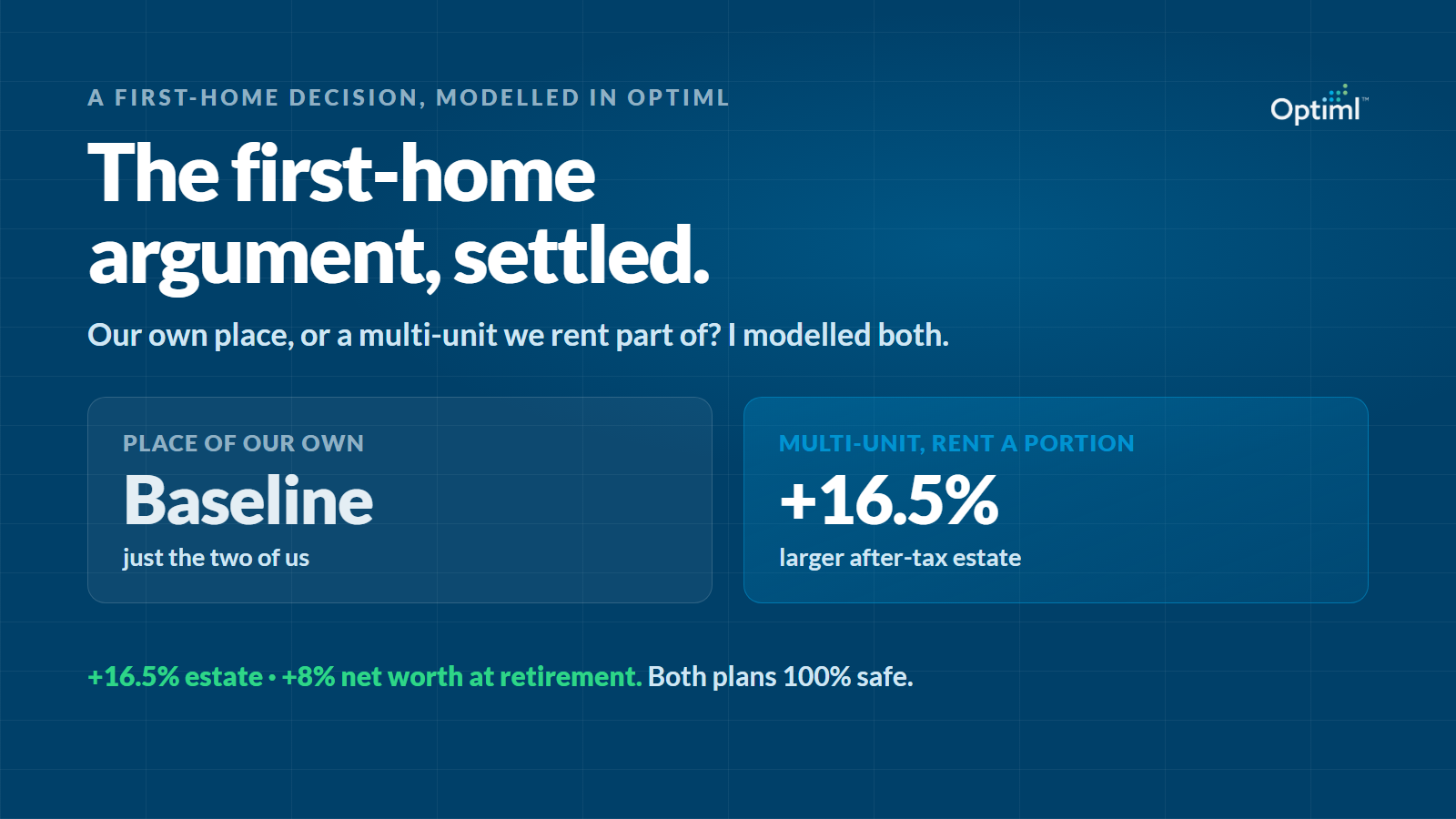
Across an identical life, with the same income, the same spending, and the same investing, the only real change being the home, the multi-unit plan ended with an after-tax estate about 16.5% larger. It carried roughly 8% more net worth at retirement and about 7.2% more real estate equity. The two plans tracked within a few percent of each other for the first 25 years, then split apart once we reached retirement, where the gap widened past 10%.
The paradox: it paid more tax and still won
Here is the counterintuitive part I love. The multi-unit plan paid about 10% more in lifetime tax. A bigger asset and more income along the way mean a bigger tax bill. And it still finished roughly 16.5% ahead.
That is the lesson I come back to constantly. The goal was never to pay the least tax. It is to keep the most after tax. A plan can pay more tax and leave you wealthier, because what compounds underneath matters more than the tax you see on the way. Paying less tax is easy. Ending up with more is the actual game.
Both plans work, so this was never about survival
One more thing the model made clear. Both versions hit a 100% Success Score, Optiml's Monte Carlo measure of whether a plan holds up across hundreds of market scenarios. Whichever we choose, we retire comfortably. If anything, both plans hint we could spend a little more freely than we are inclined to.
That reframed the whole decision. This was never "can we afford to retire." It was "which choice leaves the strongest legacy." And that is the layer a mortgage calculator cannot show you, because it stops at the closing table instead of following the decision out fifty years.
So we finally have our answer
Buying your first home is emotional, and it should be. A place of your own is a real, valid thing to want, and the optimal answer is not always the one you have to pick. But for two people who genuinely could not agree, seeing both futures laid out end to end did what months of debating could not. It gave us a clear answer, the confidence that either way we are safe, and an honest price tag on the romantic option.
We know what we are doing now, and we made the call with our eyes open, looking at where each path actually lands decades from now, not just the down payment and the monthly cost.
If you are weighing the same decision, you can model both versions of it with Compare Plans and watch them play out to the end, tax and all.
Ready to optimize your retirement plan?
Join thousands of Canadians making smarter financial decisions with Optiml.
Start Free Trial