

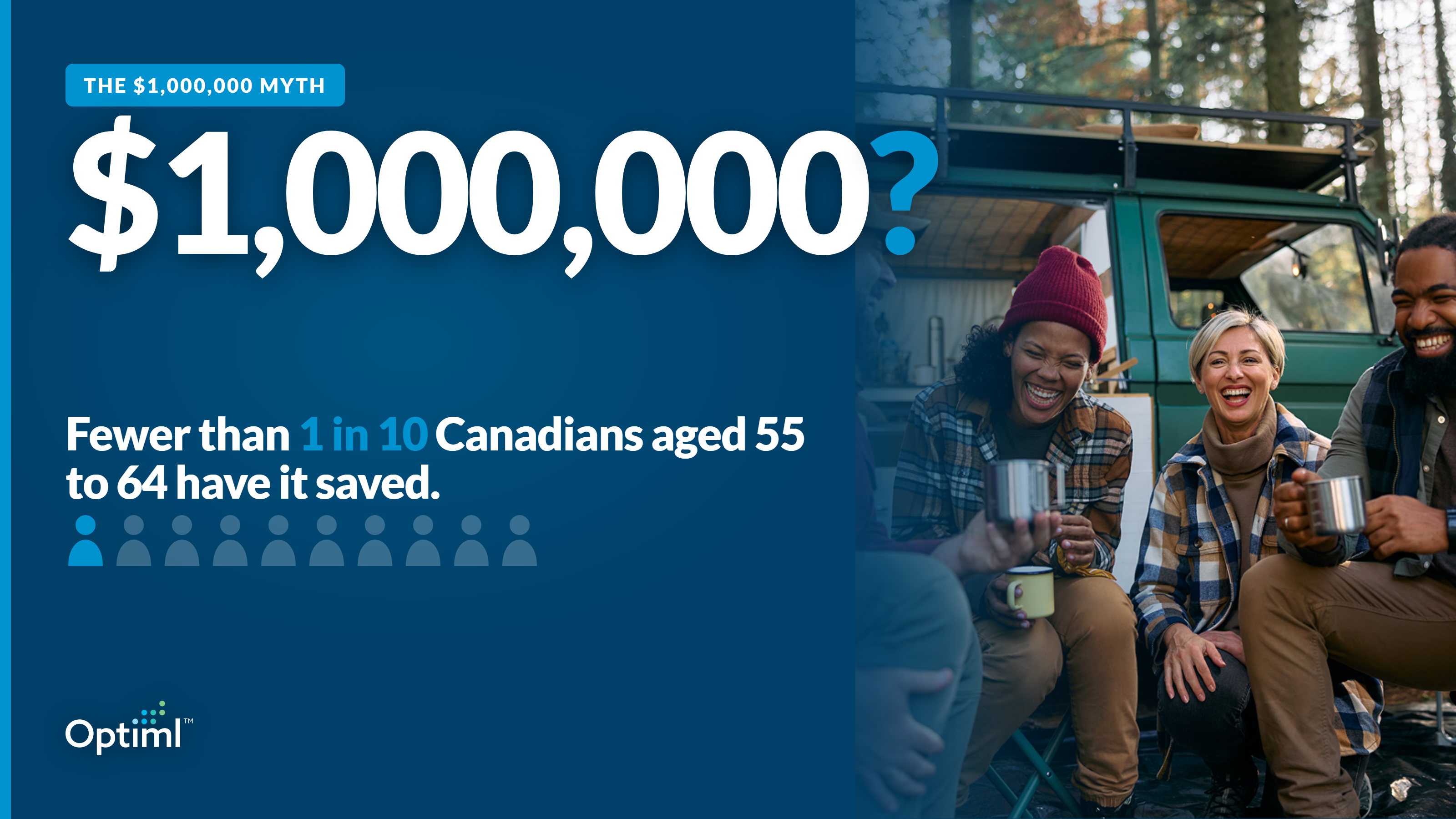
Fewer than 1 in 10 Canadians aged 55 to 64 have $1 million or more saved for retirement. That figure comes from Statistics Canada's Survey of Financial Security, surfaced through reporting by money.ca and Yahoo Finance Canada in 2025, and the measure is specific: retirement savings, for the cohort closest to retiring.
Read that the way most headlines want you to read it, and it sounds like a verdict. As though more than 90% of near-retirees are failing.
But that is the wrong way to read it. The $1 million number was never a finish line. It was a round, memorable figure that got repeated until it felt like a rule. The truth is more useful, and far less anxious: how much you have saved tells you very little about the retirement you can actually fund. What matters is what your money is, where it sits, and the order in which you draw it.
Let's take the number apart properly.
Three different millions
The single biggest mistake in this entire topic is treating one dollar figure as if it means one thing. It doesn't. When people say "a million dollars," they are usually describing one of three completely different measures, and they almost never say which.
- Retirement savings. The money specifically earmarked for retirement: your RRSP (Registered Retirement Savings Plan), TFSA (Tax-Free Savings Account), pensions, and registered investments. This is the figure behind the "fewer than 1 in 10" stat.
- Investable or financial assets. Everything you could turn into income: registered accounts plus non-registered investments and cash. Broader than retirement savings, but still excludes the house.
- Total net worth. Everything you own minus everything you owe, including home equity. This is the biggest number of the three, and it is the one most often quoted to make $1 million sound common.
The same dollar amount means three different things across those three measures. A household with $1 million in total net worth might have $650,000 of that locked in a paid-off home, a modest pension, and only a small registered balance to actually draw an income from. A household with $1 million in retirement savings is in a genuinely different position, because that money is liquid, investable, and spendable.
This is why the widely circulated "$1.4 million" Canadian figure is so misleading. It is real, but it is not a savings number. According to Statistics Canada's 2023 Survey of Financial Security, roughly $1.4 million is the median net worth of families aged 55 to 64 who both own a home and have an employer pension. That figure is home equity plus the capitalized value of a pension plus everything else, minus debt. It is mostly house and pension. It is not a brokerage balance you can spend.
Blur these three measures together and you end up comparing your savings account to someone else's house. Keep them separate, and the picture gets clear.
Where the real numbers actually sit
Once you label each measure honestly, the Canadian landscape looks very different from the headline panic. Here is the verified data, with each figure tied to what it actually measures.
Two things jump out. First, $1 million-plus in net worth is genuinely uncommon: around 5% of Canadians clear it, and that figure already includes the house. Second, the very top, the $7.4 million average of the top 1%, is a different world entirely, not a benchmark anyone should measure an ordinary retirement against.
So when a headline implies most near-retirees should have a seven-figure savings balance, it is quietly comparing you to the wealthiest fraction of the country, using a number that usually counts home equity you can't easily spend. That is not a fair comparison, and it is not a useful one.
$1 million isn't a finish line, it's a balance
Here is the part the headlines never get to. Even if you did have exactly $1 million saved, that number alone would not tell you what kind of retirement it buys. Because a million dollars is not a single thing. It is a balance sitting in accounts that are taxed in completely different ways.
Consider two Canadians, both 65, both with exactly $1 million saved. One has it entirely in an RRSP. The other has it entirely in a TFSA.
The RRSP holder has $1 million of pre-tax money. Every dollar withdrawn (and eventually, every dollar inside the RRIF, or Registered Retirement Income Fund, it converts to) is taxed as income. Draw a $60,000 income from it and a meaningful slice goes to tax before it ever reaches the chequing account.
The TFSA holder has $1 million of already-taxed money. Withdrawals are tax-free and don't count toward income at all. The same $60,000 lands in full, and because it isn't income, it doesn't push up OAS (Old Age Security) clawback or affect income-tested benefits.
Same headline number. Two genuinely different retirements. The TFSA million quietly supports a higher and more flexible after-tax lifestyle than the RRSP million, even though a net-worth statement would show them as identical. (These are simplified, illustrative figures to show the mechanism, not a projection of any specific plan.)
Most real Canadians hold a mix: some RRSP, some TFSA, maybe a non-registered account, a pension, and CPP (Canada Pension Plan) and OAS waiting in the wings. Which means the question "do I have enough?" can never be answered by the size of the pile alone. It depends on the composition of the pile, and on how you draw it down.
What actually matters
So shift the question. Stop asking "how big is my number?" and start asking the questions that actually determine your retirement:
- What after-tax spending does my money sustain? Not the gross balance. The real, spendable income it produces after tax, year after year.
- In what order should I draw my accounts? Sequencing RRSP, TFSA, and non-registered withdrawals in the right order can lower your lifetime tax bill and stretch the same savings further.
- When should I start CPP and OAS? Taking them early, on time, or deferring to 70 changes both your monthly income and how your other accounts get drawn around them.
- How resilient is the plan if markets disappoint? A plan that works at a 7% return and breaks at 4% isn't really a plan. It's a hope.
Notice that none of these questions is "how do I get to a million." They are all about turning whatever you have into the most secure, tax-efficient income possible. That is a question you can actually answer, and act on, regardless of the size of your balance.
It is also the question the headlines never ask. The 2025 BMO Retirement Survey found Canadians believe they need about $1.54 million to retire, down from $1.67 million in 2023, and 76% worry they won't have enough. But that $1.54 million is a belief, an averaged guess, not the output of anyone's actual plan. A guessed target you didn't model is exactly the kind of number that breeds worry without direction. A modeled target tells you where you stand and what to do next.
Run your own number
The honest answer to "how much do I need" isn't a national average or a round headline figure. It is your number, built on your accounts, your spending, and your timeline. And it is far more reachable than a seven-figure myth makes it feel.
This is exactly what Optiml is built to do. Instead of chasing someone else's million, you model your real situation across every account, and Optiml shows you what it actually sustains. Your Success Score stress-tests your plan against 50 market scenarios drawn from over 50,000 generated return paths, and returns a single resilience number out of 100, so "am I on track?" stops being a feeling and becomes a measurement. Every Optiml plan models the optimal withdrawal sequence across your accounts to lower your lifetime tax bill, and the CPP & OAS Optimizer finds the start ages that fit your full picture.
If you want to go deeper on the psychology of these big round targets, two earlier posts pair well with this one: "The $2M Race" on why chasing a number misses the point, and "What $1.7M Actually Buys You" on translating a balance into real retirement income.
The Bottom Line
Fewer than 1 in 10 near-retirees have $1 million saved, and that statistic says almost nothing about whether you can retire well. The number conflates savings, investable assets, and net worth, three different things people quote as one. What decides your retirement isn't the size of the balance. It's what the money is, where it sits, and the order you draw it.
Stop measuring yourself against a headline. Run your own number instead.
It was never about the million. It's about the plan.
Ready to optimize your retirement plan?
Join thousands of Canadians making smarter financial decisions with Optiml.
Start Free Trial