

The FIRE movement grew up
For years, FIRE (Financial Independence, Retire Early) meant one thing. Save aggressively, hit a number, and walk away from work in your 40s. But the Canadians actually chasing it have moved past that definition.
A recent Yahoo Finance Canada piece captured the shift well. The goal has moved from an early exit to something the movement now calls work optional.
Laura Sondy, an organizational behaviour professor at the University of North Carolina, points to FIRE author Tanja Hester's term "work optional" as the better frame. The common thread across today's FIRE followers, she says, is "a desire for more autonomy over the conditions of their work and life." Fewer hours. A lower-stress role. The ability to step back if the job stops being worth it.
The timing makes sense. Robert Half Canada found that 47% of Canadian professionals reported burnout in 2025, up from 42% in 2024 and 33% in 2023. When almost half the workforce is running on empty, "I want the option to ease off" stops being a luxury goal and becomes a mainstream one.
We agree with the reframe. We'd go further with it.
A feeling of flexibility is not the same as a modeled one
This is where we push. Agreeing that FIRE should be about options is the easy part. The hard part is that most people who say "I probably have options" have never tested that belief against their own numbers.
"I think I could go part-time at 55" is a feeling. It's a reasonable, hopeful, gut-level read on your finances. But optionality you cannot measure is not optionality. It's a hope.
An option you can actually exercise sounds different. It sounds like: "I can drop to three days a week at 55, it costs me roughly this much in lifetime spending, and my plan still funds the retirement I want." That's a modeled option. The gap between the two is the gap between guessing and knowing.
Your options are line items, not vibes
Every version of "work optional" is a specific change to a specific plan. Take one person and look at the forks in front of them:
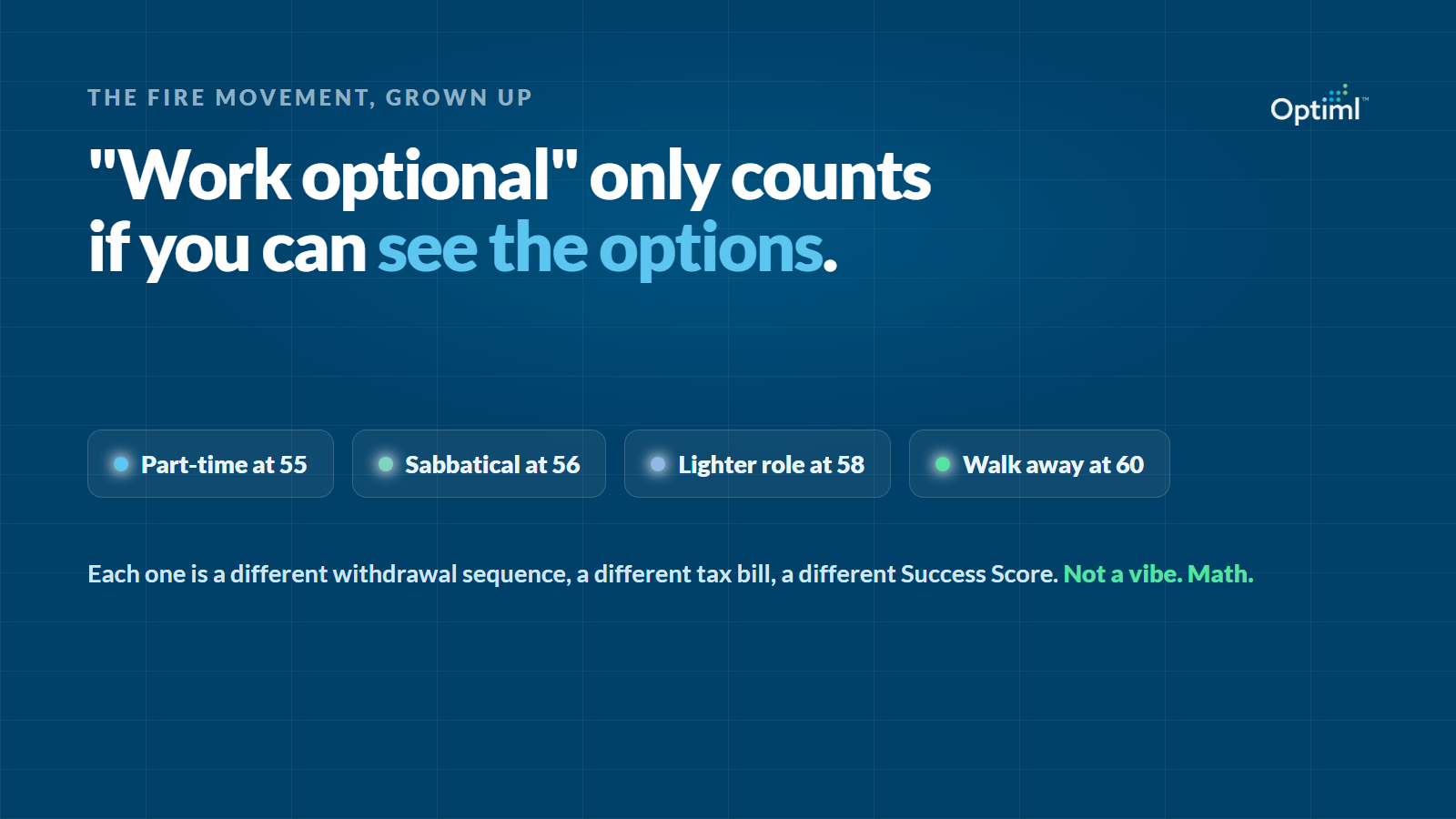
- Drop to part-time at 55. Lower employment income for a decade, which changes when you start drawing from your RRSP (Registered Retirement Savings Plan) and TFSA (Tax-Free Savings Account), and what tax bracket you sit in while you do it.
- Take a one-year sabbatical at 56. A single gap year that has to be funded from somewhere. The account you pull from changes your tax bill for that year and the room you carry forward.
- Move to a lower-paying, lower-stress role at 58. Less income now, possibly a longer runway, and a different CPP (Canada Pension Plan) contribution picture.
- Walk away entirely at 60. Full decumulation starts early, which reshapes your withdrawal sequence for the next 30-plus years.
Each of those is a different withdrawal sequence, a different lifetime tax bill, and a different level of resilience. None of them is a vibe. They're all math, and the math is knowable before you commit to any of them.
This is exactly what we built Optiml to show. The Success Score turns "I think I'm free" into a number out of 100, stress-testing your plan across hundreds of market scenarios (a Monte Carlo simulation). Compare Plans puts two or three of those options side by side, so "part-time at 55" and "walk away at 60" stop being competing hunches and become a comparison you can actually read.
Be honest about the income bar
There's a reason the options framing matters more than a hard FIRE number for most Canadians: the classic FIRE math is out of reach for a lot of people.
Saijal Patel, founder of Saij Elle, calls the traditional target of saving 50-70% of your income "a stretch for most Canadians." By her estimate, a household needs roughly $80,000 to $84,000 after tax (about $110,000 to $120,000 before tax) to sustain a $3,200 to $3,500 monthly cost of living while pursuing FIRE.
Fee-for-service planner Ed Rempel puts it more starkly for a single earner. A single person in Toronto earning $75,000, roughly $4,700 a month take-home, would need closer to $140,000 a year to make a traditional FIRE trajectory work.
For most Canadians, that bar isn't realistic. And that's the whole point. If full, retire-at-45 FIRE is off the table, the spectrum is where the real value lives. Coast FIRE, Barista FIRE, and partial retirement are all versions of "work optional" that don't demand a six-figure savings rate. They just require you to know which lever you can actually pull, and when.
We've made a version of this argument before: retirement isn't a switch you flip once, it's a dimmer you turn down over years. Part-time at 60, a lighter role at 62, fully done at 65. The options mindset is the same idea applied earlier, and it only works if you can see the cost of each setting.
Don't just adopt the options mindset. Test it.
The Yahoo piece gets the direction right, and the Canadians it profiles are thinking about this the healthy way. Our only addition is this: don't stop at the mindset. A mindset that isn't measured is still a guess.
If you want the full mechanics of how FIRE actually works in the Canadian system, from the TFSA and RRSP backbone to the emergency-fund math, we laid it all out in The Ultimate FIRE Guide for Canadians 2026. Start there for the how.
Then come back to the part that's actually about you. Optiml lets you model each option on your real numbers and watch what it does to your plan, your taxes, and your Success Score. Not estimate it. See it.
Optionality you can measure is real. Optionality you can only feel is just a hope with better branding.
Ready to optimize your retirement plan?
Join thousands of Canadians making smarter financial decisions with Optiml.
Start Free Trial