

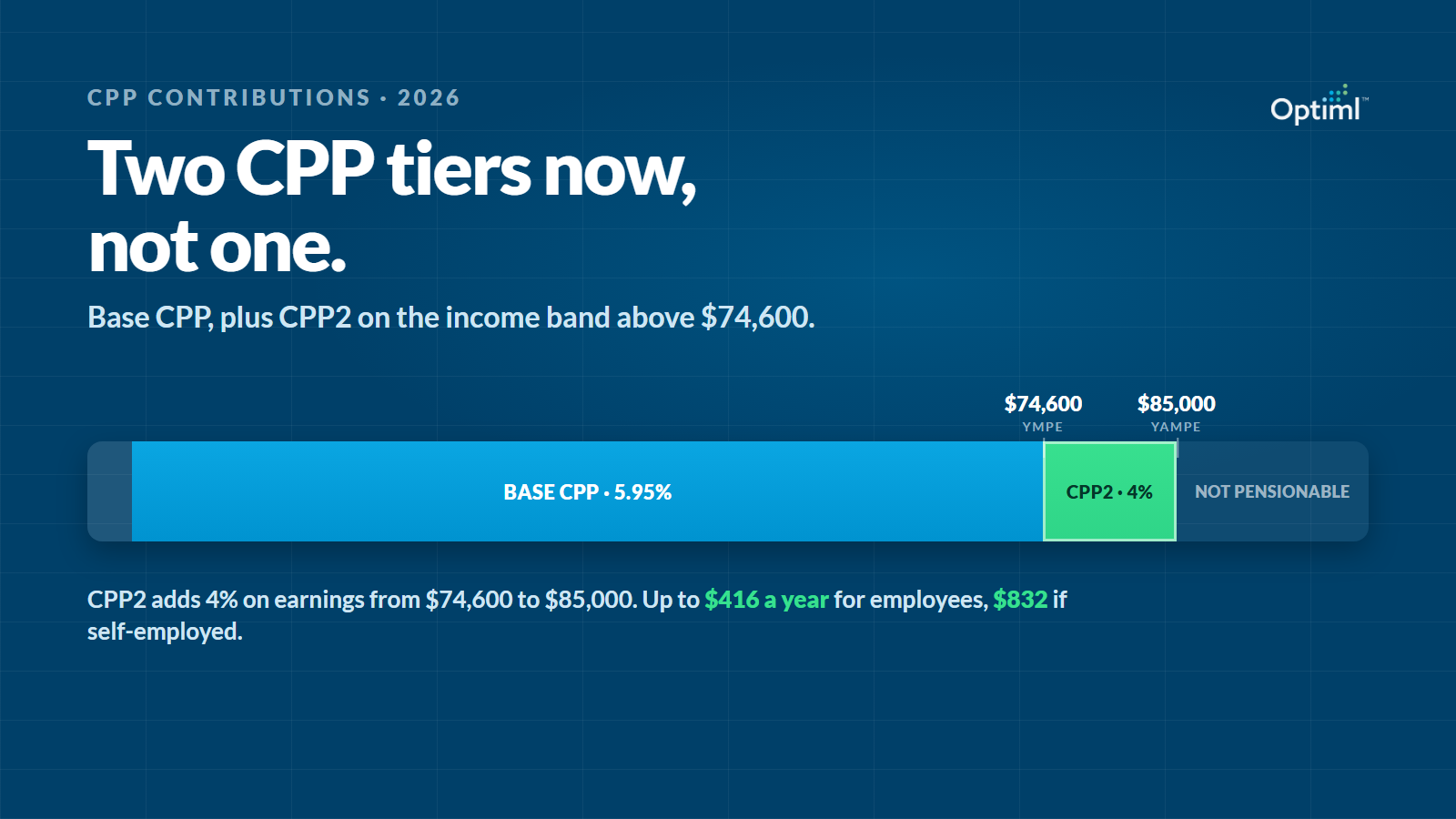
Most Canadians think of the Canada Pension Plan (CPP) as a single line on their pay stub. One deduction, one rate, done. But since 2024, there has been a second CPP contribution quietly layered on top of the first. It is called CPP2, and in 2026 it reaches further up the income scale than ever before.
If you earn more than $74,600 in employment or self-employment income this year, you are paying it. Most people have no idea what it is, who it applies to, or what it actually buys them decades from now.
So let's clear it up.
What CPP2 actually is
CPP2 is not a new tax and it is not a replacement for your regular CPP contributions. It is a second, separate contribution tier that sits on top of base CPP, and it only applies to a specific band of higher earnings.
To understand it, you need three numbers:
- YMPE (Year's Maximum Pensionable Earnings): the first earnings ceiling. In 2026 it is $74,600 (up from $71,300 in 2025). Your base CPP contributions apply to earnings between the $3,500 basic exemption and this ceiling.
- YAMPE (Year's Additional Maximum Pensionable Earnings): the second, higher ceiling. In 2026 it is $85,000 (up from $81,200 in 2025). This is the top of the CPP2 band.
- CPP2: the contribution you make on earnings between the first ceiling ($74,600) and the second ceiling ($85,000).
So the structure is layered. Base CPP covers your earnings up to $74,600. CPP2 covers the slice from $74,600 to $85,000. Income above $85,000 is not pensionable at all, meaning no CPP of any kind comes off it.
This all comes from the CPP enhancement, a two-phase upgrade to the plan. Phase 1, from 2019 to 2023, gradually raised the base contribution rate from 4.95% to 5.95%. Phase 2 introduced CPP2 in 2024, adding that second earnings band. In 2024 the second ceiling was only 107% of the first. From 2025 onward, the permanent formula sets it at 114%, which is why the CPP2 band roughly doubled in width between 2024 and 2025.
The 2026 numbers at a glance
Here is the full picture for 2026, with 2025 alongside for comparison. All figures are from the Canada Revenue Agency's official maximum-pensionable-earnings release.
The employee and employer each pay their own share. Employees pay 5.95% on base earnings and 4% on the CPP2 band, and the employer matches both. A self-employed Canadian pays both halves, so the rates double to 11.9% base and 8% on the CPP2 band.
Who actually pays CPP2, and who doesn't
This is the part most people get wrong. CPP2 is not a universal deduction. It only kicks in once your individual employment or self-employment income clears the first ceiling of $74,600.
- Earn under $74,600? You pay base CPP only. No CPP2 comes off your income at all.
- Earn between $74,600 and $85,000? You pay CPP2 on the portion above $74,600, up to a maximum of $416 as an employee.
- Earn above $85,000? You max out CPP2 at $416, and every dollar above $85,000 is not pensionable. No further CPP is deducted.
So CPP2 lands squarely on higher earners, roughly those above $70,000 to $75,000 in individual income. It is worth stressing the word individual. These ceilings apply per person, not per household. A couple each earning $80,000 both pay CPP2. A single earner bringing in $150,000 pays it once and stops contributing entirely above $85,000.
For employees, this is fully automatic. Your payroll system handles both base CPP and CPP2, and the deductions simply appear on your pay stub. There is nothing to opt into and nothing to file. Self-employed Canadians handle it themselves, remitting both the employee and employer share at tax time when they file their return.
What you actually get for it
Higher contributions are only half the story. The other half is what those contributions buy you decades from now.
The CPP enhancement is designed to raise the share of pre-retirement income that CPP replaces. The old CPP was built to replace roughly 25% of your eligible earnings. The enhancement lifts that target toward 33%. CPP2 is the piece that extends this higher replacement rate to the upper earnings band, the slice between the two ceilings that previously earned no CPP credit at all.
In plain terms: contributing on that higher band of income now means a larger CPP retirement pension later.
But here is the honest caveat, and it matters most for anyone reading this who is close to retirement. This is a gradual, decades-long build. The full effect of the enhancement, and of CPP2 specifically, requires a near-full career of enhanced contributions. Because CPP2 only started in 2024, someone retiring in the next few years will see only a partial effect. A 25-year-old starting their career today captures far more of it than a 60-year-old who has just two or three CPP2 years on their record.
That does not make it meaningless for near-retirees. It just means the boost to your specific pension is smaller and more precise than the headline "33%" suggests, and it needs to be modelled against your actual contribution history, not assumed.
Why this matters for retirement planning, not just payroll
It is easy to file CPP2 under "payroll trivia" and move on. That would be a mistake, because your CPP contributions do not exist in isolation.
Higher lifetime contributions, including your CPP2 years, feed a larger modelled CPP entitlement. And a larger CPP entitlement changes the math on almost every other decision in your retirement plan. More guaranteed CPP income has to be weighed against Old Age Security (OAS) clawback thresholds, against the timing of your Registered Retirement Savings Plan (RRSP) and Registered Retirement Income Fund (RRIF) withdrawals, and against the single biggest CPP question of all: what age to start taking it.
These pieces interact. A bigger CPP pension taken at 70 can push you into OAS clawback territory if your RRIF withdrawals are not sequenced around it. This is exactly the kind of interaction Optiml's CPP & OAS Optimizer is built to model, weighing your projected CPP against your full income picture to find the start age that fits your situation.
We won't re-explain the take-up decision here. If you want the deep dive on whether to start CPP at 60, 65, or 70, we walk through the full math in a separate post: When to take CPP: 60, 65, or 70.
The Bottom Line
CPP2 is not a surprise tax and it is not something to fight. It is a second contribution tier on higher earnings, fully confirmed for 2026, that trades a modest cost today for a larger CPP pension later. If you earn over $74,600, you are already in it.
The number on your pay stub is the easy part. The real work is figuring out what your enhanced CPP means for when you claim it, how you draw down everything else, and how you stay clear of the OAS clawback along the way.
CPP2 isn't just a line item. It's an input.
Frequently Asked Questions
What is CPP2?
CPP2 is the second tier of the Canada Pension Plan enhancement, introduced in 2024. It is a separate contribution on employment or self-employment income between the first earnings ceiling (YMPE, $74,600 in 2026) and the second ceiling (YAMPE, $85,000 in 2026). It sits on top of base CPP rather than replacing it.
Who has to pay CPP2?
Anyone whose individual employment or self-employment income exceeds $74,600 in 2026. If you earn less than that, you pay base CPP only and no CPP2. The ceilings apply per person, not per household.
How much is CPP2 in 2026?
The CPP2 rate is 4% each for the employee and the employer, on earnings between $74,600 and $85,000, to a maximum of $416 each. Self-employed Canadians pay both halves at 8%, to a maximum of $832. A maxed-out employee pays up to $4,646.45 in total CPP for 2026 (base plus CPP2); a maxed-out self-employed person pays up to $9,292.90.
Does CPP2 increase my CPP retirement pension?
Yes. CPP2 extends the enhanced income-replacement rate, which lifts the CPP target from roughly 25% of eligible earnings toward 33%, to the higher earnings band that previously earned no CPP credit. The full effect builds over a near-full career of contributions, so Canadians close to retirement will see only a partial boost since CPP2 began in 2024.
Is CPP2 automatic or do I opt in?
For employees, it is fully automatic. Payroll deducts both base CPP and CPP2, and there is nothing to sign up for. Self-employed Canadians remit both the employee and employer share themselves when they file their tax return.
Do self-employed Canadians pay CPP2 differently?
The rate band is the same ($74,600 to $85,000), but self-employed Canadians pay both the employee and employer share, so the CPP2 rate is 8% instead of 4%, up to a maximum of $832 in 2026. They pay it at tax time rather than through payroll.
Ready to optimize your retirement plan?
Join thousands of Canadians making smarter financial decisions with Optiml.
Start Free Trial