

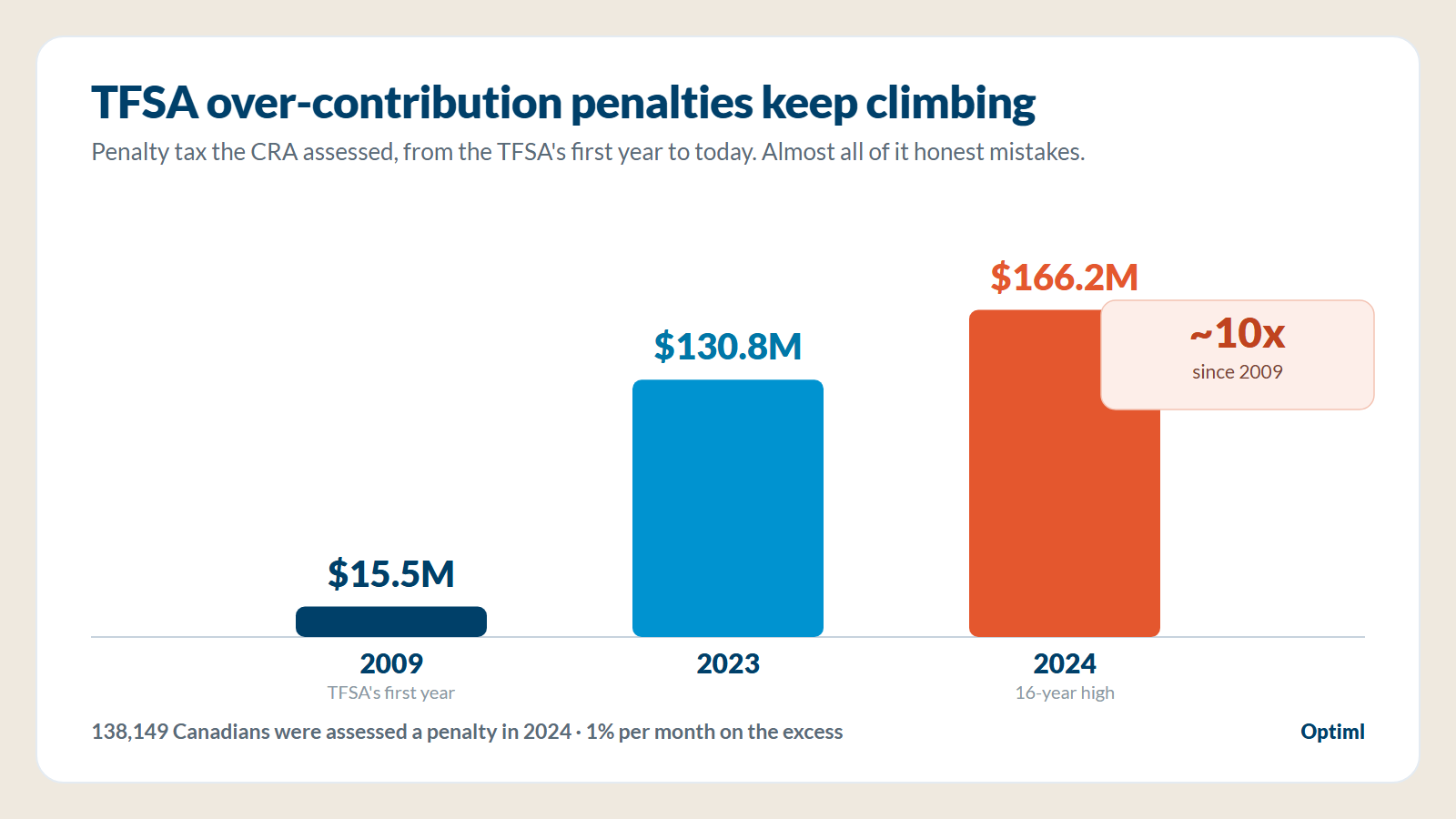
In 2024, the Canada Revenue Agency (CRA) assessed about $166 million in over-contribution penalty tax on Tax-Free Savings Accounts (TFSAs). That is not a typo. One hundred and sixty-six million dollars, in a single year, on one of the simplest accounts Canadians own.
Here is what makes that number worth stopping on: nobody over-contributes to a TFSA on purpose to get ahead. There is no advantage to be gained. You cannot game a TFSA by stuffing extra money into it. So this is not a pile of tax collected from people trying to cheat the system. It is overwhelmingly a pile of honest mistakes.
And it is a pile that keeps growing. In 2009, the first year the TFSA existed, the equivalent figure was roughly $15.5 million. Fifteen years later it has climbed about tenfold. In 2024, 138,149 Canadians were assessed a TFSA over-contribution penalty, a 16-year high, up from 79,767 back in 2009.
The reasonable reaction is: how does a mistake with zero upside happen to 138,000 people a year? The answer is not that Canadians got worse at math. It is that the system that could prevent this leaves them to track it by hand.
The room number already exists. It just isn't shown to you in time.
Here is the part that should bother everyone. The only reason the CRA can assess these penalties at all is that it already has the data.
Every financial institution reports every TFSA contribution and every withdrawal to the CRA. That is precisely how an over-contribution gets flagged and a TFSA Notice of Assessment gets issued. The room number, the amount you are allowed to put in, is not a mystery locked in a filing cabinet somewhere. It exists. It is calculable. The institutions feed it in.
The problem is that the number is not surfaced to you in real time. The figure you see in CRA My Account lags. It updates after institutions do their annual reporting, not the moment money moves. So the room number a Canadian checks in, say, June can easily be months out of date and not reflect this year's contributions at all.
That lag is exactly how a careful person over-contributes. Two situations catch people again and again:
- After a withdrawal. When you pull money out of a TFSA, that room does not come back until January 1 of the following year. Withdraw $10,000 in March, re-deposit it in July thinking you are "just putting my own money back," and you have over-contributed by $10,000 until the new year.
- Across multiple institutions. If you hold TFSAs at two or three banks or brokerages, no single one sees your total. Each shows only its own slice. The full picture lives only at the CRA, on a number that lags.
Notice what both of these have in common. The person did nothing greedy or clever. They tracked as best they could against the only figure available to them, and the figure was stale.
A penalty that mostly catches good-faith mistakes is a design failure
Let me be clear about what I am and am not saying. The CRA applying the rules as written is not the villain here. The rules are the rules, and enforcing them consistently is the job. The CRA has shifted from mailing educational letters toward assessing over-contributions directly off institution data, and factually, that is what is driving the numbers up.
The villain is the missing infrastructure. In 2026, there is no good reason a Canadian should have to hand-track this figure across multiple institutions and simply hope they got it right.
Think about how your bank already treats an overdraft. Try to spend money you do not have and the transaction gets stopped, or you get warned, in real time, at the point of the decision. The system knows your balance and protects you from stepping over the line. A TFSA contribution is a strictly easier problem. The room number is known. The contribution is known. An institution could hard-stop an over-contribution the same way, or at minimum flag it before it happens.
The penalty itself is not gentle either. It runs at 1% per month on the excess amount, and it keeps compounding every month until you withdraw the excess. So a stale number and a re-deposit can cost someone real money, month after month, for a mistake they did not know they were making.
A penalty is supposed to be a deterrent. But you cannot be deterred from a mistake you have no way to see coming. When a penalty overwhelmingly catches honest tracking gaps rather than bad actors, it has stopped being a deterrent and become a tax on missing tooling.
This is one gap among many, and the bar should be higher
The TFSA penalty story is a clean example of a much bigger pattern. Canadian personal finance is full of infrastructure gaps that better tools should have closed years ago. Contribution room that lags. Account data scattered across half a dozen institutions that never talk to each other. Decisions like when to start CPP or how to draw down your accounts that carry six-figure consequences and get made off a rough guess.
The information almost always exists. It is just fragmented, delayed, or buried in a format nobody can act on. And for too long, the response has been to hand the individual a stack of statements and wish them luck.
That bar is too low. For institutions and for the fintechs building alongside them, the standard should be preventing the foreseeable mistake, not documenting it after the fact.
Where tools like Optiml fit
Optiml is part of a wave of Canadian tools trying to fill exactly these planning voids. The core idea is simple: give people one full-picture view of their accounts and their plan instead of a drawer full of disconnected statements.
To be straight with you, Optiml is not a live TFSA-room tracker and it does not sit between you and your bank to block an over-contribution as it happens. That is not what it does. What it does is model your whole retirement across every account you own, so decisions get made against a complete picture rather than a fragment. The reason mistakes like this one land so hard is fragmentation, and a holistic plan is the antidote to fragmentation.
That is the direction the whole ecosystem should be building in. Fewer fragments. More full pictures. Fewer foreseeable mistakes left for the individual to catch alone.
How to protect yourself today
Until the tooling catches up, the responsibility still lands on you. Here is how to stay on the right side of the line.
Your TFSA over-contribution checklist
- Check CRA My Account, then verify against your own records. Treat the My Account figure as a starting point, not gospel. It lags. Keep your own running tally of contributions and withdrawals for the current year.
- Remember the January 1 rule. Money you withdraw does not free up room again until January 1 of the next year. Re-depositing in the same calendar year is the single most common way careful people trip.
- Be extra careful with multiple institutions. If you hold TFSAs at more than one bank or brokerage, no one of them sees your total. You are the only one who does. Track the combined number yourself.
- If you do over-contribute, act fast. Withdraw the excess immediately to stop the 1% monthly penalty from compounding, and file form RC243, the TFSA return, for the year in question.
The Bottom Line
One hundred and sixty-six million dollars a year, from 138,000 Canadians, on a mistake with no upside and a data trail the system already holds. That is not a story about people being careless. It is a story about a country that has the information and has not yet put it where people can use it.
Canada can do better here, and it will. The data exists, the problem is understood, and the tools to close gaps like this one are being built right now.
The mistake was never the hard part. Showing people the number in time is.
Frequently Asked Questions
How much did the CRA collect in TFSA over-contribution penalties?
In 2024 the CRA assessed roughly $166 million in TFSA over-contribution penalty tax, up from about $130.8 million in 2023. For scale, the figure was around $15.5 million in 2009, so it has climbed roughly tenfold in about 15 years. In 2024, 138,149 Canadians were assessed a penalty, a 16-year high.
Why do so many people over-contribute to a TFSA?
Almost always by honest mistake, driven by three things. First, the contribution room shown in CRA My Account lags because it updates after institutions do their annual reporting, so the number is often out of date. Second, withdrawn room does not come back until January 1 of the following year, which catches people who re-deposit money in the same year. Third, if you hold TFSAs at multiple institutions, no single one sees your total.
What is the TFSA over-contribution penalty?
It is a tax of 1% per month on the highest excess amount in your account for that month, and it keeps applying every month until the excess is withdrawn. Because it compounds monthly, an over-contribution left in place can cost real money over time.
Does the CRA already know my TFSA contribution room?
Yes. Financial institutions report every TFSA contribution and withdrawal to the CRA, which is how over-contributions get flagged and assessed. The catch is that the figure surfaced to you in CRA My Account lags real time, so the number you see may not reflect your most recent activity.
How do I avoid over-contributing to my TFSA?
Keep your own running tally of contributions and withdrawals for the current year and treat the CRA My Account figure as a starting point rather than the final word. Do not re-deposit withdrawn amounts until January 1 of the next year, and if you hold TFSAs at more than one institution, track the combined total yourself. If you do go over, withdraw the excess right away and file form RC243.
Ready to optimize your retirement plan?
Join thousands of Canadians making smarter financial decisions with Optiml.
Start Free Trial