

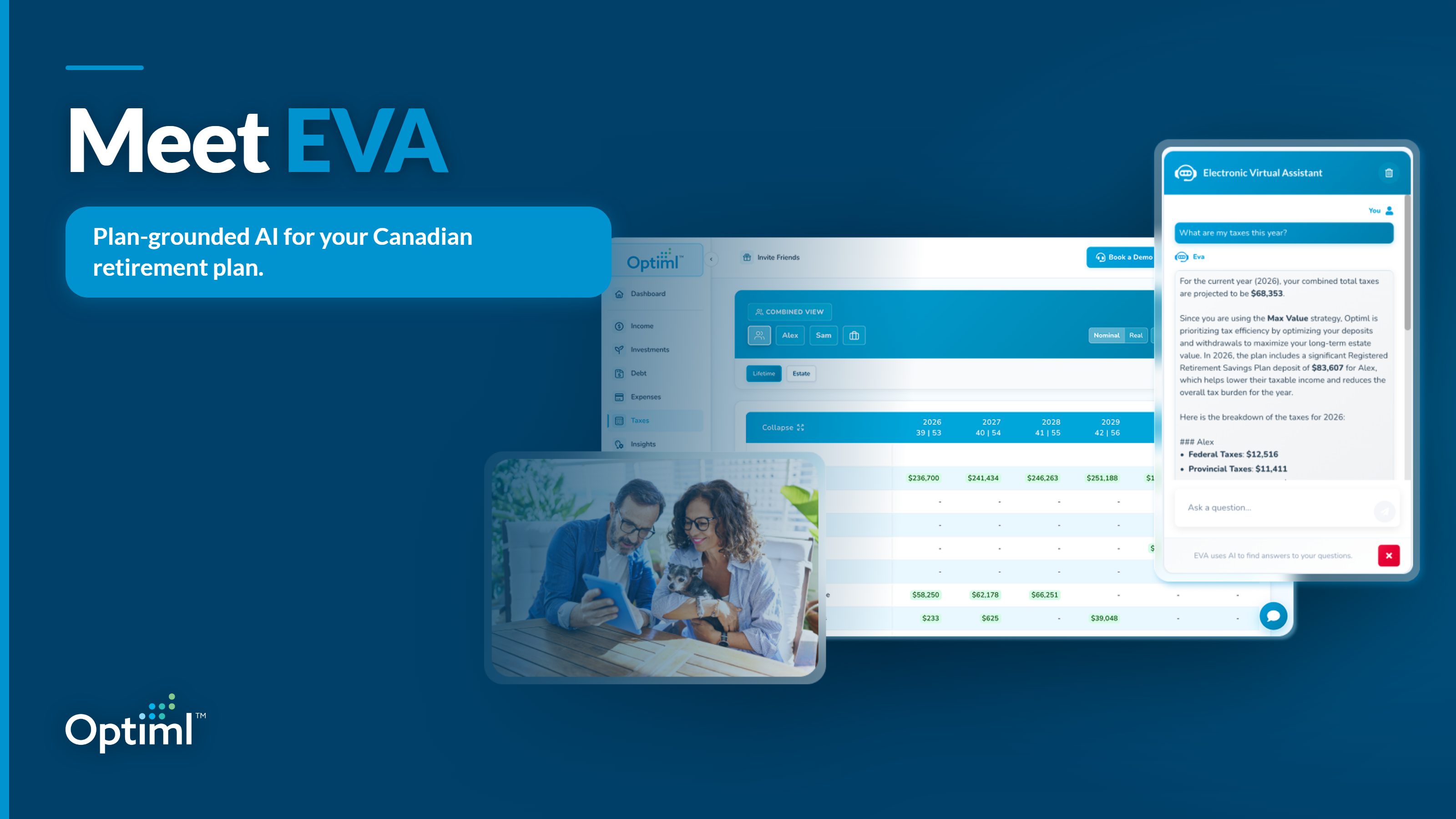
Eva has now answered more than 30,000 questions from Optiml users. When we first built it, I was terrified every time someone clicked the chat icon. The first version of Eva was not good, and we scrapped the entire thing.
This is the story behind that reset. It is also a piece about why generic AI chatbots fail for retirement planning, and what had to change for an AI financial assistant in Canada to actually be useful.
Why we killed the first version of Eva
Honestly, when we first built Eva, the goal was much smaller. We wanted to replace generic customer support and help users navigate the platform. Where do I change my assumptions? How do I compare two plans? That sort of thing.
Barely anyone used it. And every time someone actually asked it a real question, I was terrified of what Eva was going to say back. So we scrapped it.
The problem was not the technology. The problem was the mental model. In 2024 and 2025, almost every SaaS company bolted a generic chatbot onto their product. Ours was no different. That playbook works fine for a calendar app or a project management tool. It fails for software that touches six-figure retirement decisions.
A Canadian opening their retirement plan is not sitting there wondering where the tax settings page lives. They are wondering whether deferring CPP (Canada Pension Plan) to 70 makes sense given their other income. They are wondering whether their spouse should start Old Age Security (OAS) at 65 or wait. They want to understand their plan. Not the app. The plan.
Once I saw that clearly, the support-chatbot framing looked silly. We had to start over.
Why generic AI chatbots fail for retirement planning
This is the part most people skip. Before I explain what plan-grounded AI is, it is worth being honest about why the default approach (plug ChatGPT into a sidebar, call it an assistant) cannot solve a Canadian retirement question.
They have no context about you. A generic large language model does not know your RRSP (Registered Retirement Savings Plan) balance, your spouse's projected OAS start age, whether your pension is indexed, what province you live in, or how much non-registered capital you have. It can explain a rule. It cannot apply that rule to your numbers.
They are U.S.-biased. Most large language models are trained overwhelmingly on U.S. content. Canadian retirement is a completely different machine. RRIFs (Registered Retirement Income Funds), TFSAs (Tax-Free Savings Accounts), pension income splitting, OAS clawback thresholds, GIS (Guaranteed Income Supplement), provincial brackets, CPP actuarial adjustments: none of this maps cleanly to a 401(k) or a Roth IRA. Ask a generic assistant about RRIF minimum withdrawals and you often get a confident, Americanized answer that is subtly wrong.
Their hallucination rate is a real problem. Independent testing on finance-specific queries has shown generic assistants returning wrong answers close to four times out of ten, with a meaningful share of those answers sounding confident enough to mislead. For casual questions that is annoying. For decisions about when to take CPP, it is dangerous.
They have no memory of the plan. This is the biggest one. Even when a generic assistant gives a correct abstract answer about CPP deferral, it cannot tell you what your plan already recommends, or why. It cannot reason about the specific tradeoffs your situation creates. The answer is always one level too high.
What plan-grounded AI actually means
This is the centrepiece of the rebuild, and the reason Eva works today.
Eva uses RAG (Retrieval Augmented Generation). But not the kind most AI assistants use. Most assistants point RAG at a pile of generic content: documentation, articles, FAQs, product help. The model searches that pile for relevant passages, then answers. It is a well-read librarian who has never met you.
Eva's RAG is pointed at one thing only: your plan, your inputs, and your assumptions. Your projected balances, your withdrawal sequence, your CPP start age, your marginal tax rate in 2031, your OAS clawback exposure in 2036, your Success Score, the moves Optiml is recommending, and the moves it rejected. That is the entire context window. No generic finance content, no U.S.-biased training filler, no articles. Just your numbers and the decisions your plan has already modelled.
The analogy I use: a generic RAG chatbot is a well-read librarian who has never met you. A plan-grounded assistant is a financial planner who spent an hour studying your file before you walked in the door. Same underlying technology. Very different input.
It sounds simple. It took us a long time to get right.
Why Eva doesn't do the math (and why that matters)
Here is a line I repeat to every new user, every investor, and every journalist who asks how Eva works: Eva does none of the math. Not one number. Not a CPP adjustment, not a tax bracket calculation, not a Monte Carlo projection, not an OAS clawback estimate. Zero.
Every number Eva references comes from Optiml's deterministic calculation engine. The engine is the thing we have been building and hardening for years. It knows every federal and provincial tax bracket, every CRA rule, every pension mechanic, every RRIF minimum formula, every CPP and OAS actuarial adjustment. It runs thousands of scenarios to find the optimal withdrawal sequence and produces every projected dollar figure inside your plan. That is the math.
Eva is the interpreter.
This separation is deliberate, and it is the most important design decision in the product. Large language models are brilliant at language. They are unreliable at arithmetic, especially arithmetic tied to evolving rules like CRA indexing, provincial bracket changes, or pension indexation formulas. Ask a generic AI to compute a 2029 OAS clawback with the right threshold, the right indexation factor, and the right recovery rate, and you can get confident numbers that are occasionally, silently wrong. That is unacceptable for a product people use to make six-figure decisions.
So we split the job. The engine computes. Eva explains.
What Eva is genuinely excellent at:
- Interpreting numbers the engine already produced. Why did your CPP recommendation land at 67 and not 65? Eva reads the engine's output and walks you through the reasoning.
- Walking through scenarios holistically. What if you retired two years earlier? What if your spouse deferred OAS? Eva describes the tradeoffs in plain language, using the results the engine already modelled.
- Comparing the general shape of tradeoffs. Early CPP versus late CPP. RRSP meltdown versus TFSA-first. Paying down the mortgage versus investing. Eva describes how the levers interact and which direction they push your outcome.
- Helping you actually set up the model. If a conversation surfaces a scenario worth testing, Eva points you at the exact inputs to change inside Optiml so the engine can model it properly. The conversation ends with a plan to run, not a number to trust from a chatbot.
This is why I stopped being terrified every time someone opened the chat. The worst case used to be Eva inventing a tax answer. That cannot happen anymore, because Eva is not permitted to invent numbers. If the engine has not modelled a scenario, Eva says so and shows you how to model it. If the engine has modelled it, Eva's job is to translate the output into something a human can actually act on.
AI that makes financial decisions should be terrifying. AI that helps you understand and act on a deterministic plan, built on a verified calculation engine, is the opposite. It is the first time most Canadians have had a real financial expert on their side.
What a real Eva answer looks like
The clearest way to show what plan-grounded means is to walk through the kind of questions Eva gets every day. Here are three real patterns.
"Why does my plan recommend delaying CPP to 67 instead of 65?"
Eva pulls the user's other income sources in the 65-67 window: a bridge pension that ends at 67, planned RRSP drawdown, rental income. It pulls the CPP actuarial adjustment for each month of deferral. It pulls the user's marginal tax rate at 65 versus 67, the life expectancy assumption in the plan, and the lifetime tax outcome under each scenario.
Then it explains it. Taking CPP at 65 would stack on top of the bridge pension and push the user into the next bracket, meaning a meaningful chunk of those CPP dollars would be taxed at a higher rate and clawed into OAS exposure later. Deferring to 67 smooths income across those two years, reduces the effective rate on every CPP dollar received, and unlocks a higher indexed benefit for life. It gives the modelled lifetime-tax difference between the two paths for that specific user, not a generic rule of thumb.
"What is the tax impact if I withdraw from my RRSP three years earlier?"
Eva pulls the user's current withdrawal sequence, the projected RRSP balance at age 71, the marginal tax rate in the earlier years versus the later years, OAS clawback exposure after 77, and the Success Score impact of the alternate sequence.
It explains that pulling RRSP income forward can drain the balance faster, reduce the forced RRIF minimum at 72+, and avoid a clawback spike at 77 when an old LIRA (Locked-In Retirement Account) conversion is projected to land. The cost is slightly higher near-term tax. The benefit is a lower lifetime tax bill and a better Success Score. It quantifies the tradeoff for this plan. Not as a generic principle. As a modelled number.
"How do I avoid the tax spike in 2028 when my pension starts?"
Eva pulls the pension start date, the pension amount, the user's and spouse's other income sources in 2028, available pension income splitting, and remaining TFSA and non-registered room.
It walks through the levers. Pension income splitting with the spouse drops the combined bracket. Bringing some RRSP meltdown into the years before the pension starts flattens the curve. Redirecting non-registered draws away from that year reduces the interest and dividend layer stacked on top. It names which option the plan is already modelling and what the alternative would do to the numbers.
There is range beyond these three. Eva also handles questions like "should I pay down the mortgage or invest?" (yes, really) because the answer is never abstract. It depends on your TFSA room, your marginal rate, your mortgage rate, and the Monte Carlo on your retirement date.
How this changes what Optiml can do at scale
Here is the part I still cannot fully wrap my head around.
Thousands of Canadians use Optiml today. Only about 6% of Canadians have an ongoing relationship with a financial advisor, and most of the ones who do pay $2,500 to $4,000 for a one-time plan that then sits in a PDF drawer. Meanwhile the questions that actually matter: why does my plan say this, what if I change that, when should I pull this lever, are the questions a PDF cannot answer.
Understanding the why behind your plan, evaluating real tradeoffs, and moving forward with confidence is not something you solve with a help doc, a support queue, or a ticket system. You solve it by giving every user their own financial expert, available on demand, grounded in their real numbers.
That is what Eva is. And that is why the number that still catches me off guard is not the 30,000 questions. It is the fact that every one of those questions got a personalized answer, for the price of a streaming subscription, by someone who actually read the plan first.
What's next for Eva
Eva is live and it is improving every month. The next wave of work is around proactive prompts (Eva flagging the question you should be asking, not just answering the one you typed), deeper integration with Compare Plans and the Success Score so it can explain why one scenario beats another, and continued expansion of the plan-data context it can reason over.
It is not finished. No plan-grounded AI ever is.
The bigger mission
Every Canadian deserves the clarity and confidence to take control of their retirement. The barrier has always been access to expertise. Financial planning has been expensive, opaque, and rationed. The default has been to wing it and hope.
Eva is the step that breaks the access barrier. Plan-grounded AI is the technology that makes it possible. And this is why I stopped being terrified every time someone clicked the chat icon: because the answer Eva gives now is the answer I would want someone to give my parents.
It is not about replacing advisors. It is about finally giving every Canadian an expert in their corner.
Eva is included in Optiml Pro+ and Legacy plans. Start your 14-day free trial at optiml.ca and ask it your first question today.
Ready to optimize your retirement plan?
Join thousands of Canadians making smarter financial decisions with Optiml.
Start Free Trial