

Most Canadians treat their retirement plan as a January project. RRSP (Registered Retirement Savings Plan) season arrives, the late-February deadline creates urgency, and everyone scrambles to move money before the window closes.
But waiting until January to look at your plan means you spend most of the year flying blind. By the time the deadline forces your hand, your options for the year are already narrowing.
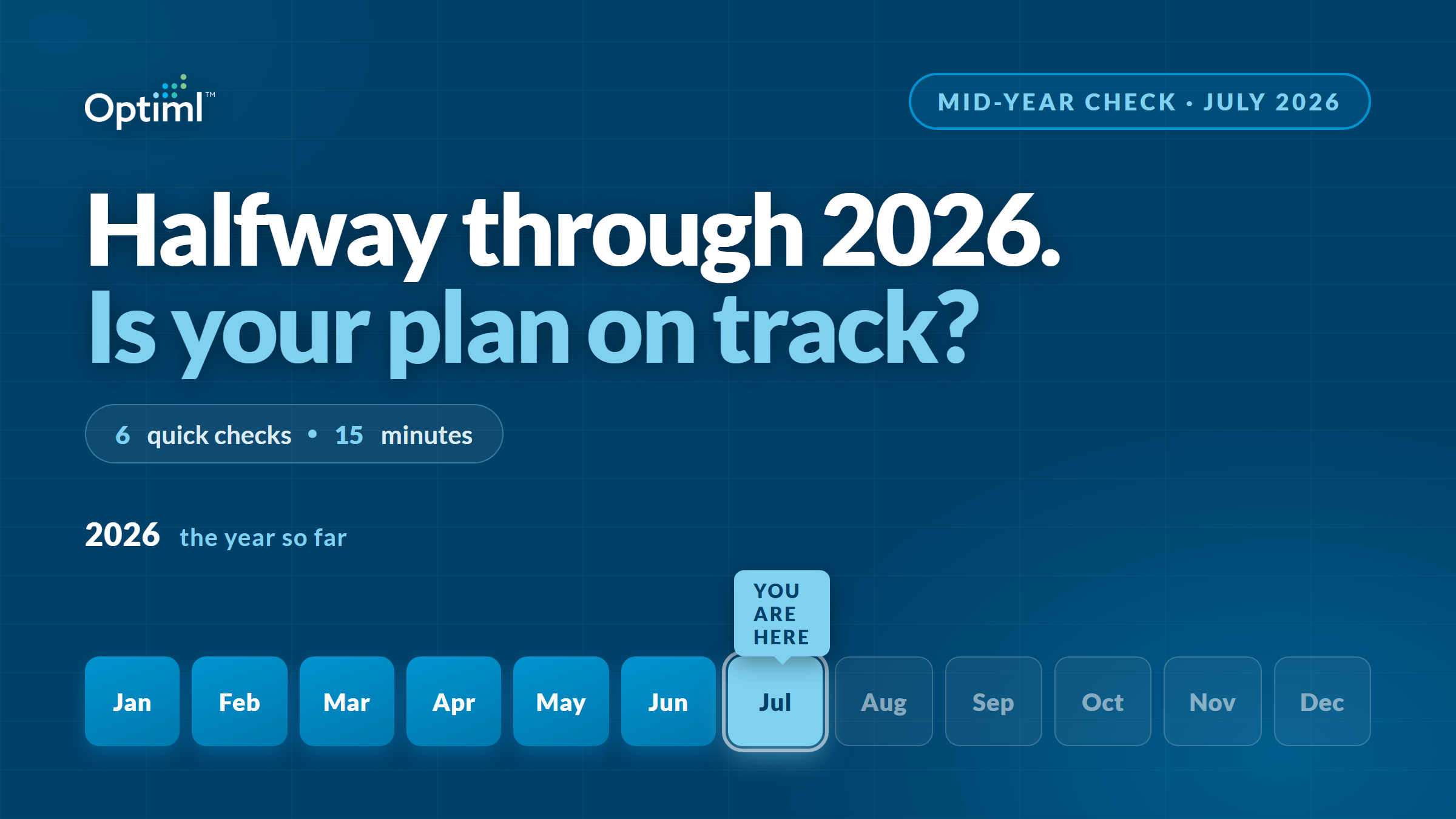
July is the better checkpoint. You are exactly halfway through the year. There is still time to adjust your contributions, revisit a benefit-timing decision, or course-correct your spending before year-end. The pressure is off, which is precisely why the thinking is clearer.
Here is a mid-year check you can run in about 15 minutes. Six questions, each one worth answering while you still have half a year to act on it.
The 15-Minute Mid-Year Retirement Check
1. Check your remaining TFSA room
The TFSA (Tax-Free Savings Account) added $7,000 in new room for 2026. If you have been eligible every year since the program launched in 2009 (18 or older that year and a Canadian resident throughout), your cumulative room now sits at roughly $109,000.
Mid-year is the moment to check two things: how much room you actually have left, and whether you are using it in the right order relative to your other accounts. The TFSA is the most flexible account you own. Every dollar of growth inside it comes out tax-free and never counts toward the OAS clawback later. That makes it a powerful tool in retirement, not just a savings account.
If you have an FHSA (First Home Savings Account) as well, check that room too. It carries its own annual limit and its own contribution rules.
2. Pace your RRSP contributions now, not in February
Your 2026 RRSP room is 18% of your prior-year earned income, up to the annual maximum, plus any unused room carried forward. The deadline to contribute for the 2026 tax year does not land until the first 60 days of 2027.
That distance is the point. If you wait until the deadline, you are making a large, rushed decision in a single February cheque. If you check your pace in July, you can spread contributions across the back half of the year, smooth out the cash-flow hit, and avoid the year-end scramble entirely.
Ask yourself the simple version: at your current rate, will you hit your intended contribution by the deadline? If the answer is no, you have six months to fix it rather than six weeks.
3. Revisit your CPP start-age decision
The CPP (Canada Pension Plan) is one of the highest-stakes timing decisions in your entire plan, and the numbers are not small. Taking it early permanently reduces the benefit. Deferring it permanently increases it.
The gap between taking CPP at 60 and taking it at 70 is enormous over a full retirement. There is no universally correct answer. It depends on your other income, your health, your tax bracket, and your spouse's situation. The break-even point between deferring to 70 and starting at 65 typically lands somewhere around age 83 to 84.
You do not need to lock this in today. You just need to know it is a live decision, not a default. This is where Optiml's CPP & OAS Optimizer earns its place: it models your exact crossover age based on your complete financial picture, rather than a rule of thumb.
4. Know your OAS clawback exposure
The OAS (Old Age Security) recovery tax, better known as the clawback, quietly reduces your benefit once your net income climbs above an annual threshold. The rate is 15 cents of OAS lost for every dollar of income above that line, and the threshold is indexed each year.
Two details matter for a mid-year check. First, the clawback is based on your prior year's net income, so the income you generate this year shapes next year's benefit. Second, it is one of the most avoidable costs in retirement, because it is driven by how and when you draw income, not just how much you have.
If you are approaching or already in the clawback zone, this is the moment to notice it. Large mandatory RRIF withdrawals, a big capital gain, or poorly sequenced drawdowns can all push you over the line. Seeing it in July gives you time to plan around it.
5. If you are already retired, check your spending and withdrawal order
For retirees, the mid-year question is different. It is not "am I saving enough?" It is "am I drawing down in the right order, at the right pace?"
Check two things. First, your spending: are you on track with the budget you set, or has the reality of the year drifted from the plan? Second, and more importantly, the order you are pulling money from. Drawing from the wrong account in the wrong year can inflate your tax bill and trigger clawback exposure you never needed to face.
Every Optiml plan models the optimal withdrawal sequence across every account, every year, based on your specific tax situation and goals. That sequencing is where a lot of quiet, lifetime tax savings live. A mid-year look tells you whether the year so far still lines up with the optimized path.
6. Pull your Success Score as a mid-year baseline
The first five checks each answer one piece of the puzzle. This one answers the whole thing in a single number.
Your Success Score is Optiml's retirement resilience score, out of 100. It stress-tests your full plan against 50 market scenarios drawn from over 50,000 generated return paths, built on historical Canadian and US market returns. Your score is the percentage of those scenarios in which your plan fully funds the retirement you actually want.
A score of 100 means your plan holds up in every scenario tested. A lower score tells you exactly where it gets fragile: an early market downturn, a stretch of high inflation, a longer-than-expected retirement.
Checking your Success Score in July gives you a baseline for the year. Run it now, make your adjustments, and you have a clean reference point to measure against when you do your year-end review. It turns "I think I'm on track" into a number you can actually watch move.
The Bottom Line
None of these six checks takes long on its own. Together they answer the only question that really matters at the halfway mark: am I still on track, and if not, do I have time to fix it? In July, the answer to that second part is almost always yes.
Optiml pulls all six of these into one place. It models every account and every year at once, so your TFSA room, your CPP timing, your clawback exposure, your withdrawal order, and your Success Score are not six separate spreadsheets. They are one connected plan you can run in about 15 minutes.
The best retirement plan is not the one you build in January and forget. It is the one you actually check.
Halfway through the year is the perfect time to look.
Ready to optimize your retirement plan?
Join thousands of Canadians making smarter financial decisions with Optiml.
Start Free Trial